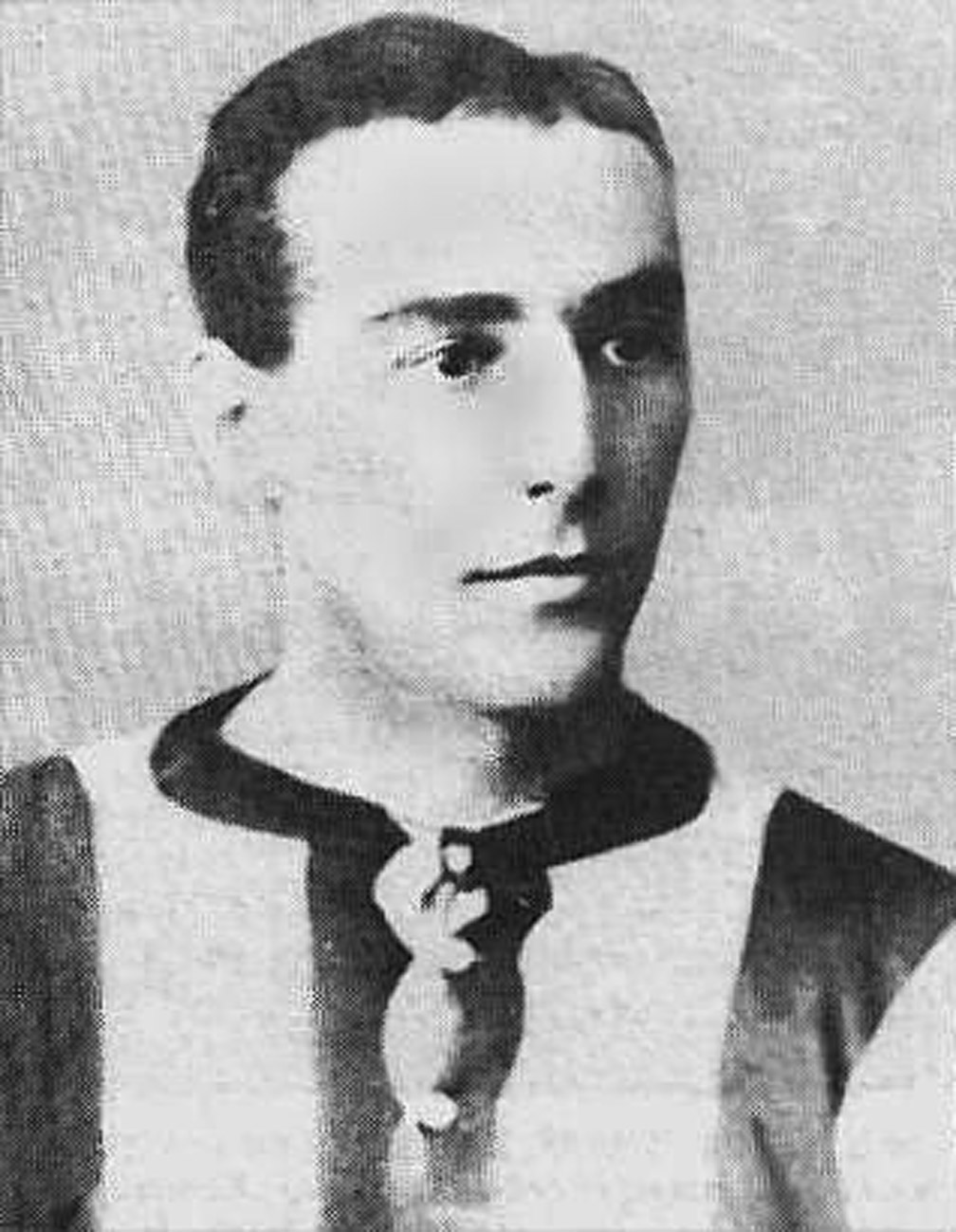
Gillespie: William Ballantrae (Billy)
1910-1912 (Leeds City Player Details)
Inside Forward
Born: Kerrykeel, Donegal: 06-08-1891
Debut: v Blackpool (h): 03-09-1910
5’10” 11st 6lb (1910)
Nicknamed “Spider”, and son of a policeman, he spent the early part of his playing career in junior football in Londonderry, but it did not take long for his talent to be spotted,
and at the tender age of just seventeen Derry Institute captured his signature. Around this time, the Drumahoe-based club, Institute, were credited with discovering the famous
Billy Gillespie. Frequently capped by Ireland, Gillespie made his debut for the club against Idlers FC at Brandywell in a junior league match, a game which Institute won 2-1. Two
weeks later, however, he was deemed too young to play in the historic cup final victory over Wanderers. Institute lost his services at the start of the 1910-11 season when he
received and accepted a tempting offer from Leeds City. He was about to sign for Linfield when Leeds City secretary-manager Frank Scott-Walford, scouting for players in the
Emerald Isle, persuaded him instead to cross the water and sign professional forms for the English Second Division outfit in May 1910. Scott-Walford had been alerted to his
talents earlier, when watching him score twice in a junior international match against Scotland at Celtic Park. Gillespie and countryman Joe Enright were given rave reviews after
their displays in pre-season warm ups, Gillespie netting a hat trick in the contest between the Whites and the Stripes. Both men were given debuts in the opening game against
Blackpool on 3rd September 1910, with Gillespie leading the attack. Billy McLeod, the regular centre-forward, who had been injured, returned the following week at Gillespie's
expense. The Irishman scored a hat trick in the reserves and was back at centre-forward on 24th September 1910, with McLeod switching to inside-right for the match at
Huddersfield. With Hugh Roberts on the right flank, Enright at inside-left and Fred Croot outside him, that same forward line played unchanged for nine games. Gillespie opened
his scoring account for City in the 1-1 draw with Birmingham at Elland Road on 1st October 1910. He fired past the keeper early on after a move which he had started in his own
half. That goal set him off on a scoring spree and Gillespie scored seven times in the following eight games, including the only goal of the game against Hull City at home on 15th
October 1910, City's only goal in a 1-2 loss to Fulham at Craven Cottage. Then came two braces against Gainsbrough Trinity at home on 12th November 1910 and Stockport
County away, on 26th November 1910, as both ended in 4-0 victories. His final goal came at Wolverhampton Wanderers at Molineux on 24th December 1910. For all that, the
Irishman was not without his critics and after a 3-3 draw with Chelsea on Boxing Day, he was dropped to allow McLeod to resume at centre-forward, with Tom Mulholland at inside
-right and Joe Enright at inside right, with Hugh Roberts on the right and Fred Croot on the left wing. He appeared only twice more all season finishing with nine goals in eighteen
League appearances. After playing in the first four games of 1911-12, when Joe Enright missed the first game, Tom Mulholland, the next two and Fred Croot the fourth. Gillespie
was left out again and only played two more matches for City, both due to Fred Croot's absence against Burnley at home on 9th and Wolverhampton Wanderers away on 16th
December 1911. On both occasions, Leeds shipped five goals. Gillespie scored from a penalty in the first game, when he was rated the Peacocks' outstanding forward. They
were his last games for City as Sheffield United signed him for a bargain £500 in December and it soon became apparent that City had made a big mistake in parting with the
talented Irishman. While it did help with the financial problems of City, Billy Gillespie was an all time Irish great and it was astonishing that Leeds City should allow him to slip
through their fingers. On 22nd December, the Yorkshire Post broke the news that the Irishman would be leaving Elland Road. "We are informed by Mr Scott-Walford, the Leeds
City manager, that he has transferred W. Gillespie to Sheffield United at what is stated to be a record fee for the Leeds City club. Gillespie has been regarded as one of the most
useful of the Irish brigade at Elland Road. He was secured from the Londonderry Guild club at the beginning of last season, and has played regularly with Leeds City either in the
centre-forward or inside-left position. He has played with such success in the latter position that his transfer in the present critical state in the club's affairs may occasion surprise,
but, the management felt, in the circumstances, that they could not reasonably refuse Sheffield United's offer for his transfer. According to Ivan Sharpe, Gillespie's generalship and
captaincy for Ireland exceeded even his successes with Sheffield United. An easy going inside left of straight forward methods, Gillespie had the golden gift of piercing a defence
with one long, accurate pass". "In reality the transfer has been forced by the trend of recent events. Gates of late at Elland Road have not been sufficient to pay the ordinary
expenses of the club, and when Sheffield United weighed in with what is stated to be a bigger fee than has ever before been paid for the transfer of a Leeds City player, the
management felt that the interests of the club demanded its acceptance. We have reason to believe that the fee is something approaching or something exceeding £400 and if
that be so the acceptance of Sheffield United's cheque will go some way towards tiding over Leeds United's financial embarrassments." The additional funds might have eased
City's financial difficulties, but it was a massive error of judgement on the club's behalf; Gillespie went on to prove himself one of the outstanding Irish talents of all time, enjoying a
Twenty-year career at Bramall Lane and scored over 130 goals in nearly 500 games. Sheffield United signed Gillespie from Leeds City in December 1912 for £500 for the
maximum wage, then £4 per week. Gillespie made his debut on Boxing Day 1911, scoring in a 2–2 draw with Newcastle United and played regularly for the Blades from that
point on. In the period from his signature and the end of 1911-12 he scored eleven League goals in seventeen League games and one in the F.A. Cup for the Blades as they
finished fourteenth in the First Division. His second season at Bramall Lane, 1912-13, saw him score eight goals in twenty-five League appearances and one in his one F.A. Cup
game as Sheffield did not improved, finishing fifteenth. It also saw his International debut. He made an outstanding debut, scoring twice in a 2-1 win over England in the home
championship at Windsor Park, Belfast on 15th February 1913, quickly followed by his second cap just one month later, but on this occasion Scotland prevailed 2-1 at Dalymount
Park in Dublin. The 1913-14 season saw him add two more caps to his collection with two goals in a 2-1 win over Wales at The Racecourse in Wrexham on 19th January 1914
and then another goal on 14th February 1914 in a 3-0 win over England at Ayresome Park, Middlesbrough, which took him to five goals in four games for Ireland and It took Ireland
to the top of Home International table for the first time. World War One saw the end of International for the duration of the War. In the League Sheffield improved a little more to finish
tenth but carried all before then before falling at the last fence in the F.A. Cup semi-final in 1913-14. Not unusually, the Blades gave a big fight before surrendering holding the initial
tie to a 0-0 draw on 28th March 1914 at Old Trafford before going down by 1-0 in the replay at Goodison Park on 1st April 1914. Gillespie played his part with twelve goals in thirty
appearances in the League and another two goals in eight appearances in the F.A. Cup. In the 1914-15 season the League carried on until the end of the season, but Gillespie was
denied an FA Cup Winner's medal in 1915, when he missed United's 3-0 victory over Chelsea at Old Trafford with a broken leg, received in the first game of the season against
Sunderland in September 1914. It proved to be his only game of the season with United being able reach sixth place even without his presence. No competitive football was played
between 1915 and 1919 due to the First World War instead there were regional division, where players guested for the team that was local to them on a matchday. Sheffield United
were in the Midland League and Gillespie was able to play for them, and scored ten goals in thirty appearances in the 1915-16 season and then again he scored six goals in twenty
-four games, but as he served as a gunner, with his brother Peter, as the war intensified he was hardly ever available as his one game, in which he scored a hat-trick in 1917-18
and one game and no goals in 1918-19 would indicate and it was in this time that he lost most of his hair. Sheffield United were in the First Division when peace-time football
recommenced in 1919-20 and Gillespie returned to United and resumed his place in the first-team, although now playing a more withdrawn role as an inside forward. The Blades
never seemed to be in the race for honours finishing in fourteenth place in 1919-20, Gillespie scoring four goals in twenty-nine League appearances and could not find the net in his
only game in the F. A. game. He added two more caps to his collection, now totalling six, as on 14th February 1920 Ireland drew 2-2 with Wales at the Oval in Belfast and on 13th
March 1920 were beaten 3-0 by Scotland at Parkhead in Glasgow. The 1920-21 season was not a good one for the Blades as they barely staved off relegation, finishing twentieth
with thirty points. Gillespie scored just four goals in thirty-three League appearances and none in his one F.A. Cup tie. He did add just one cap to his collection on 23rd October
1920 as Ireland were defeated 2-0 by England at Roker Park, Sunderland to bring his total to seven. 1921-22 season brought an improvement, with the Blades rising to eleventh
place and Gillespie scoring fourteen goals in thirty-one League games and two other fixtures and he brought his caps to ten and his international goals to eight with a goal in each
of the three matches as on firstly England were held to a 1-1 draw at Windsor Park, Belfast on 22nd October 1921, then came a 1-2 defeat on 4th March 1922 at Parkhead, Glasgow
by Scotland and then on 1st April 1922 Wales were held to a 1-1 draw at Windsor Park, Belfast. 1922-23 saw the Blade finish tenth and reach the semi-finals of the F.A. Cup as
Gillespie contributed nine goals in thirty-four League games and three goals in nine F.A. Cup ties and a further two goals in other games. In addition he brought his caps to thirteen
as on 21st October 1922 at the Hawthorns, West Bromwich, England ruled with a 2-0 victory, this was followed on 3rd March 1923 with Scotland getting the only goal of the game at
Windsor Park in Belfast. On 14th April 1923, he led Ireland for the first time and he scored in a 3-0 win over Wales at The Racecourse, Wrexham, to bring his caps to thirteen and
goals to nine.Sheffield United reached their best placing in a long time, when they finished fifth in Division One in 1923-24, however Gillespie himself scored just once in fourteen
games in the League and did not find the net in his one F.A. Cup appearance, but scored twice in two other games for that season. He had taken over the club captaincy from George
Utley at the start of the season and he also carried on as his country's captain for the three games, as they beat England 2-1 at Windsor Park, Belfast on 20th October 1923 with
Gillespie adding to his impressive number of goals against England. On 1st March 1924 they were beaten 2-0 by Scotland At Parkhead in Glasgow, and then two weeks later they
went down by the only goal against Wales at Windsor Park, Belfast which took his caps to sixteen and his goals to ten. 1924-25 saw the Blades drop to fourteenth place in Division
One as he made thirty-eight appearances and score nine goals. The highlight was when he led United to win the F.A. Cup with a 1-0 win over Cardiff City, with goal from Fred Tunstall
in the thirtieth minute at Wembley, but although he played six games he failed to find the net as was the case in another game. This comment came from Ivan Sharpe as he praised
Gillespie's contribution to the Blades winning the F.A. Cup: "Never has Gillespie's generalship been more marked. No player on view trapped the ball so surely, retained it with such
good judgement, and exhibited such power and precision in sending it either to the left or right wing or more delicately down the middle. Sheffield United played wonderfully well but
special praise is due to Gillespie, the man who waves a wand and whose influence has played such a vital part in United's capture of the Cup." He also led Ireland and he was again
taunting England as he got the Irish goal in a 1-3 defeat at Liverpool, but Ireland drew a blank when they were beaten by Scotland 0-3 in Belfast. He now had eighteen caps and his
goal tally was eleven. 1925-26 again saw him in the captain's role for both Sheffield United and Northern Ireland. At international level he scored one of the goals in a 3-0 win over
Wales, at Windor Park, Belfast on 13th February 1926 to taken his tally to twelve and a fortnight later he took his caps to twenty but nothing to celebrate as Scotland score a 4-0
victory, at Ibrox Park, in Glasgow. In the League the Blades took fifth place in the First Division as he scored twelve goals in thirty-nine games he also scored once in two F.A. Cup
ties and made one other appearance without scoring. In 1926-27 United finished eighth in the League, with Gillespie scoring eleven goals in thirty-eight appearances and made one
F.A. Cup and one other appearances, while on the international front he notched his thirteenth international goal when he led Ireland to a 3-3 draw with England at Anfield, Liverpool on
20th October 1926 and on 9th April 1927 took his caps to twenty-two with a 2-2 draw with Wales at Ninian Park, Cardiff. The Blades went close in the F.A. Cup as they reached the
Semi-Final and after they had drawn 2-2 with Huddersfield Town at Old Trafford,Manchester, on 24th March 1928, and a 0-0 draw at Goodison Park, Liverpool, two days later, they
finally succumbed by the narrowest of margins,1-0, at Maine Road, Manchester. the Blades dropped to thirteenth in the League with Gillespie netting five goals in thirty-four League
appearances and a further goal in the F.A. Cup in eight ties. He took his caps to twenty-three, as while Ireland won 2-0, he did not get his usual goal in the 2-0 win over England at
Windsor Park, Belfast on 22nd October 1927. He got his twenty-fourth cap, a liitle over a year later, as he again did not feature on the scoresheet as England took revenge with a 2-1
victory at Goodison Park, Liverpool on 22nd October 1928. There was a slight improvement in United's fortunes as they finished eleventh in Division One, with Gillespie netting six
goals in thirty League games and one in the F.A. Cup in his only tie and played two other games without scoring. He was now in the twilight of his career, and he collected his twenty-
fifth, and final cap and captained Ireland for the thirteenth and final time on his own home ground, Bramall Lane Sheffield, but the home team, England were not doing any favours and
it was not until ten minutes from time, that another Irish player who called Bramall Lane home, Jimmy Dunne, in only his second game for Northern Ireland scored a consolation goal
after England had scored five! Gillespie enjoyed incredible success for Ireland against England and seven of his thirteen international goals came against the English. Gillespie held
the IFA record for most international goals scored for seventy-eight years, with 13 goals. His record was equalled by Portsmouth's Colin Clarke in 1992 and broken by Leeds United's
David Healy in 2004 when the the then Leeds player took his international total to fourteen. Once more the Blades went close to relegation in the 1929-30 season, when they finished
twentieth with Jimmy Dunne netting thirty-six ,while Gillespie scored five from fourteen League games and one other game in the1929–30 season. Retaining his position for a further
three years, Gillespie began coaching United's young players in during the 1930–31 season, before retiring from playing at the end of the 1931-32. He netted three goals in sixteen
League games and played three F.A. Cup Ties but did not score but scored twice in one other game in the 1930-31 season. With his only appearance in 1931-32, he brought the
curtain down on an incredible career at Bramall Lane which saw him score one hundred and twenty goals in four hundred and forty-eight League appearances, nine in forty-four F.A.
Cup ties and twenty-five goals in seventy-one other games, of which nine goals in fifty-six games were in the war-time Leagues. He remained with United until 1932, when he returned
to Ireland for a nine-year spell as manager of Derry City. Gillespie was held in such regard that the club agreed to change their strip to red and white stripes in recognition of his career
at Sheffield United. His return to Derry, was initially as Player-Manager, but after retirement he remained as Manager, of Derry City from 1932 until 1941. He led Derry to two City Cup
triumphs and on four successive occasions they finished runners up in the Irish League. He also led them to the 1936 Irish Cup final where they eventually lost 2-1 to Linfield after the
first game had ended in a goalless draw in front of a 23,000 strong crowd at Celtic Park. Gillespie left Derry City in 1941 and during World War Two he returned to Sheffield where he
worked at Hadfields munitions works. Following World War Two he continued his connection to United, acting as a scout for his former team and compiling match and player reports
until the 1970s. Gillespie moved to the south of England following his retirement and died in his sleep in Bexley, Kent on 2nd July 1981, a month short of his ninetieth birthday. In
September 2013, a commemorative plaque was erected at Rab's Park, Kerrykeel, the local community sport field, in recognition of Gillespie's achievements and his links to the town.
| Appearances | Goals |
| League 24 | 10 |
| |