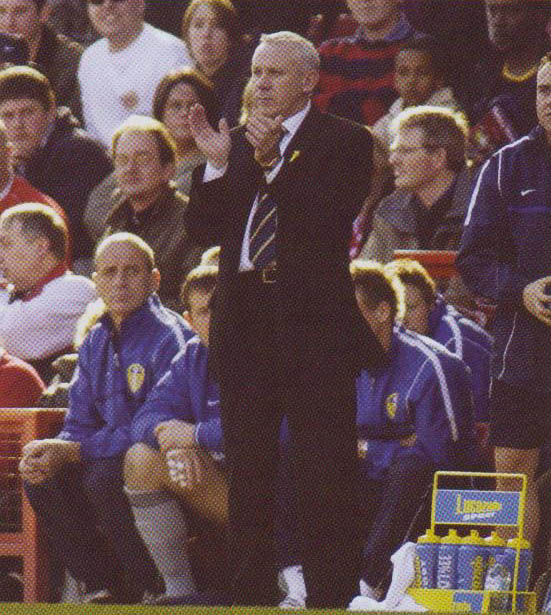
Reid: Peter
2003-2003
(Manager Details)
(Manager Details)
Born 20th June 1956 in Huyton, Liverpool, Peter Reid played schoolboy football
for Huyton Boys, a side that caused something of an upset when they won the
English Schools Trophy in 1970. Many scouts came to the games and the chance came
for Reid to join various clubs as anapprentice. He opted for Second Division
Bolton Wanderers and signed professional forms for them in May 1974. He made his
debut as a substitute against Orient in October 1974. Reid made twenty-four
starts and three substitute appearances in his debut season of 1974/75. He then
established himself in the Wanderers side and was ever-present for the next two
seasonsas he scored twice and then five times as the Trotters finished in fourth
spot in both seasons, narrowly missing out on promotion to the old First Division.
His cultured midfield play and his intense desire to be involved all the time
were features of Bolton's Second Division Championship winning side of 1977-78,
but injury struck in pre-season, and Reid missed out on Bolton's return to the
top flight. He did recover in time to play against Everton on New Years' Day,
but collided with 'keeper George Wood and suffered a broken leg which kept him
out for a whole year. He suffered another break in 1981 after Arsenal, Wolves and
Everton had all offered £600,000 for him, and eventually he achieved his dream of
playing in the topflight when he signed for Everton. He had made two hundred and
Twenty-two starts and three more off the bench and scored twenty-three goals in
the League while at Burnden Park. He was to turn out to be one of Everton's most
influential post-war signings and due to his apparent proneness to injury he was
bought at a bargain £60,000, when he was signed in December 1982. He was
restricted to just seven appearances during 1982-83 due to injury. He was fit for
the following campaign but sat out most of the autumn as Kendall lefthim on the
bench. The team struggled, and it seemed Reid had to feature eventually. Everton's
revival of the spring of 1984 after he broke into the team was not wholly
coincidental as he and Andy Gray inspired them to the FA Cup. 1984-85 was,
significantly, his most injury-free season, and resulted in his being named
Player Of The Year by his fellow professionals as he collected League
Championship and European Cup-Winners' Cup medals in possibly the finest Everton
side of all time. He nearly won a unique treble but Everton lost 1–0 to Manchester
United in the 1985 FA Cup Final. In that game, Reid was recklessly challenged by
Manchester United defender Kevin Moran who became the first player to be sent off
in an FA Cup Final. It was the season Everton finally reaped the rewards of Reid's
outstanding skill and passing. His lack of pace may have been a blessing in that
it probably led directly to his style of play, which was as simple as it was
effective. He would receive the ball and either play it off and move into space
ready to accept another pass, or strike a typically majestic long ball such as
the fifty-yarder that Gary Lineker ran onto to score in the 1986 FA Cup Final.
After gaing six England Under-Twenty-three caps he won thirteen full caps,
several of which came in England's World Cup campaign of 1986 in Mexico. After
scoring eight goals in one hundred and fifty-five League starts and four
substitute appearances, and a total of thirteen goals in two hundred and
twenty-two starts and six substitute appearances in all games, in February 1989
he moved on a free transfer to Queens Park Rangers, after he had spent the last
two seasons at Everton as Player/Coach under Colin Harvey. He only stayed at
Loftus Road until December 1989 and scored once in twenty-nine League starts
before returning to Lancashire with Manchester City and rejoin Howard Kendall,
his former Everton boss, who had taken over as Manager at Maine Road. Reid's
managerial career began in November 1990 at Manchester City. Reid was appointed
Player-Manager after Howard Kendall resigned to begin the second of his three
spells at Everton. In 1990–91, Manchester City finished fifth and equalled this
achievement the following season. In the first season of the EPL, 1992–93, City
slipped into ninth place with an increasingly stale brand of 'long ball' football
and Reid was sacked after a poor start to the following season. He had scored one
goal in ninety starts and another thirteen from the bench in League games while
at Maine Road. Following his dismissal by Manchester City, in October 1993 Reid
was persuaded by Ian Branfoot to resume his playing career with Southampton who
were then in the middle of a crisis, with the Saints fans calling for Branfoot to
be sacked with the club at a very low ebb, having lost eight of their first nine
games. Reid brought a touch of guile and stability to the Saints side and despite
playing only seven League games he made a major contribution to the team's
fortunes as Saints' season started to come together. His final game for Saints
was a 3–1 victory over Chelsea on 28th December 1993. Branfoot was sacked a few
days later and Reid was touted as a possible replacement, but he stated that,
as Branfoot had brought him to the club, it would only be fair that he left as
well. Reid joined Notts County in February 1994 but only played five League games
before he moved to Bury in July 1994 where he had one game before he hung up his
playing boots. Reid made his return to management in March 1995 with Sunderland,
who were battling against relegation in the First Division. He kept the club up
and the following season they were crowned champions of the Division and were
promoted to the EPL. The season they were relegated back to the First Division
after losing their final game of the season, so their new 42,000-seat Stadium of
Light would replace Roker Park initially as a second-tier stadium rather than one
hosting EPL football. Sunderland missed automatic promotion by one place in
1997–98, and drew 4–4 with Charlton Athletic in the Division play-off final.
Reid's side missed out on promotion after losing 7–6 in a penalty shoot-out in
one of the most dramatic games ever seen at Wembley. The following season
Sunderland bounced back from this defeat, winning the First Division with a
then-record breaking one hundred and five points. Throughout 1999–2000,
Sunderland were competing for a place in European competition but in the end
missed out after finishing in seventh place. Still, Reid's team had achieved one
of the highest finishes ever achieved by an EPL team in the season after
promotion. Striker Kevin Phillips was the highest league scorer in England and
Europe with thirty goals in the Premier League. Reid also had a brief spell as
manager of the England Under-Twenty-one team in this season. For a while in
2000–01, Sunderland were second in the League and it looked as though they would
secure qualification for the ECL, but their form dipped in the final stages of
the season and again they finished seventh. Reid's team suffered a downturn in
the 2001–02 season ending up one place above therelegation zone and with just
twenty-eight goals from thirty-eight games, fewer than any other team in the
Division. In a bid to halt the decline, Reid paid a club record £6.75 million
for Norwegian striker Tore Andre Flo from Rangers but he was not a success. Reid
was let go on 7th October 2002 after nearly eight years as Sunderland Manager.
Reid was out of work until 21st March 2003, when he was appointed interim Manager
of Leeds United after the dismissal of Terry Venables. The Elland Road club had
been hit by £80 million debts after their £100 million outlay on new players in
the space of five seasons had failed to land them a trophy. Reid kept faith with
Venables' usual team as they were beaten 3-1 at Anfield in his first game. He was
fortunate to have Dominic Matteo in place of Paul Okon and a fit Harry Kewell in
place of Nick Barmby and the team of Robinson; Mills, Radebe, Duberry, Harte;
Kelly, Bakke, Matteo; Smith, Viduka, Kewell was a team that Venables could only
dream about. A 6-1 win over Charlton Athletic at the Valley was the boost the
team needed and a hat-trick from Mark Viduka and a brace from Harry Kewell set
the standard the Australian duo were to keep up for the rest of the season. It
also took Leeds up to fourteenth place and gave them the belief that relegation
could be avoided. After losing to both Southampton and Leicester City by the odd
goal in five, it took a 3–2 away win over Arsenal, which ended the opposition's
title hopes, to see Leeds safe in the last but one game of the year. After
keeping Leeds up,he was awarded the job on a permanent basis. Leeds were still
in a poor financial state and Reid was forced to sell Harry Kewell and bring in
loan signings from abroad as replacements.He brought in a succession of Loan
players, mostly from Marseilles or other French clubs. Lamine Sakho, Zoumana
Camara, Didier Domi, Saloman Olembe, Cyril Chapuis, and the Brazilian Roque
Junior were all failures in varying degrees and his only loan player who was a
success was the talented Jermaine Pennant. His free transfer signing of Jody
Morris from Chelsea was also a failure. His new signings failed to gel and Leeds
suffered some devastating defeats and were in another relegation battle. He was
fired on 10th November 2003 after a 6–1 defeat against newly-promoted Portsmouth.
Although many of his signings left Leeds after the club was relegated, Kevin
Blackwell, who Reid had brought to Leeds as Assistant Manager, later went on to
become Manager in 2004. Reid was appointed manager of First Division side
Coventry City on 5th June 2004 with the aim of getting the club promoted to the
Premier League. His spell at Highfield Road lasted only eight months as he
departed on 6th January 2005 with the club twentieth in the CCCL. In the autumn
of 2006, it was rumoured that Reid would be returning to Sunderland as Director
of Football under new chairman Niall Quinn, who had played under Reid at
Manchester City and Sunderland, but this appointment never happened. After his
days as Manager of Sunderland Reid made occasional appearances on Sky Sports
and its related channels as a football pundit. After an absence from management
of nearly four years Reid became Manager of Thailand in September 2008, having
been linked with the position earlier in the year. He signed a four-year
contract with an aim of qualifying for the 2014 World Cup. In his first
tournament as Thai Manager Thailand beat North Korea and then drew with hosts
Vietnam to win the tournament. On 9th September 2009 his contract was
terminated by mutual consent after one year. The following day he became
Assistant Manager to Tony Pulis at Stoke City. He became Manager of Plymouth
Argyle on 24th June 2010 and stayed until 18th September 2011 when he was
sacked by the cash-strapped club. In January 2012, he was appointed Manager of
Kolkata Camelians, who paid £128,000 for his services in the inaugural Bengal
Premier League season of 2012.
| Competition | Played | Won | Drawn | Lost | For | Against |
| League | 20 | 6 | 3 | 11 | 32 | 46 |
| League Cup | 2 | 0 | 1 | 1 | 4 | 5 |
| Total | 22 | 6 | 4 | 12 | 36 | 51 |