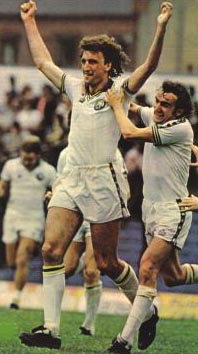
Hart: Paul Anthony (Paul)
1978-1983
(Player Details)
Centre Half
Born: Golborne, Manchester: 04-05-1953
Debut: v Liverpool (a): 11-03-1978
6’2” 12st 8lb (1979)
#86 in 100 Greatest LUFC Players Ever
Paul Hart, son of former Manchester City star Johnny Hart, played for Manchester Boys
before joining Stockport County in September 1970, making his debut a fortnight before he
signed professional forms. He made eighty-seven appearances and scored five goals before
he moved to Blackpool for £25,000 in June 1973 and proved skillful enough to warrant a few
games in midfield. He scored seventeen times in one hundred and forty-three appearances for
the Bloomfield Road club before Leeds turned to Hart in their search for a replacement for
Gordon McQueen and paid Blackpool £300,000 in March 1978. His early days at Elland Road
were marred by a flurry of own-goals and errors before he settled at the core of the Leeds
defence. He was a commanding stopper for Leeds and often tipped for England honours,
although that recognition never came his way. He was sometimes a little over-enthuisiastic
in preventing opponents from scoring and often incurred the wrath of referees for his
indiscretions, which did not help his cause in the search for higher recognition. In the
summer of 1983 a £40,000 move took him to Nottingham Forest, where he scored once in seventy
appearances and then he went to Sheffield Wednesday in the summer of 1985, where he made
fifty-two appearances and scored twice. He left for Birmingham in December 1986, but broke
his leg in his only appearance for the Blues on New Years Day 1987, in a 3-2 home win
against Plymouth Argyle. He joined Notts County as a player-coach in June 1987 for £15,000,
playing twenty-three games without scoring before becoming Chesterfield’s Manager on 2nd
November 1988. Hart spent three years at the Saltergate helm, reaching the play-offs before
a fall-out with the chairman and Hart's sacking on 1st January 1991, when they were in the
Fourth Division. He joined Grantham as a player before being appointed to the Nottingham
Forest coaching staff in July 1991. The following summer he returned to Leeds to supervise
the Leeds Youth development and enjoyed a superb first year in charge as the FA Youth Cup
was won for the first time in the club’s history. He repeated the feat again in 1997. Along
with Eddie Gray, he was responsible for many of the crop of stars produced by Leeds when
they were in the youth side, and they formed the backbone of the successful Leeds teams
over the next five or more years. Hart then returned to take charge of Forest's academy
after a high-profile fall-out with Leeds' manager George Graham over the promise of
Jonathan Woodgate. His return to Forest to take over their youth setup was a blow to Leeds.
Forest's Under-Nineteen side became immensely successful winning the Under-Nineteen title
in 1999-2000. His teams produced many fine players for Forest including several players who
were to become internationals and household names. In July 2001, Hart was appointed Manager
at the City Ground following the departure of David Platt to coach the England
Under-Twenty-One team and, after stabilising the team and the club's finances with the sales
of talented young players like Jermaine Jenas and David Prutton, he got the club into an
excellent position to challenge for promotion, but lost out in the play-offs in 2002-03,
when they were beaten in extra-time by Sheffield United in the Semi-Finals. Unfortunately,
wage demands and poor decisions meant several key players were lost in the summer of 2003,
and not replaced. Forest started the subsequent season well, but a run of just two wins in
Hart's last twenty-two games, including two months without even a goal (and fourteen games
without a win) brought the end of his tenure. Hart was sacked on 7th February 2004. Less
than a month after being forced out of the City Ground, on 4th March 2004, Hart accepted
the offer of the Manager's job at Division Two side Barnsley, but was sacked a year later,
on 4th March 2005, having failed to mount a serious promotion challenge. Promotion was
achieved by the Oakwell club the following year under Hart's successor Andy Ritchie. On 23rd
May 2006, Hart took over as manager of Rushden & Diamonds, following the departure of Barry
Hunter. Ian Bowyer, Ian Woan and Tony Godden were also brought in as back room staff. With
only a short list of players retained, Paul Hart set about signing a number of players in
June. Glenn Wilson, Paul Watson, Jon Ashton, Chris Hope and Leo Fortune-West all arrived on
free transfers, while Michael Rankine and Nicky Eyre both signed after successful trial
periods at the club. The Diamonds started the season poorly with defeats to Crawley Town and
Grays Athletic, and after a 4-1 defeat to Northwich Victoria, and with only four wins in the
first sixteen games, Paul Hart and his management team paid the price for the Club's poor
League position, Hart leaving the club on 16th October 2006 by mutual consent, with Tony
Godden taking temporary charge as Caretaker Manager. On 19th March 2007, Hart was appointed
Director of Youth Operations at Portsmouth. He became Portsmouth Manager, from 9th February to
24th November 2009, saving them from relegation in the 2008-09 season before financial problems
made his job impossible. On 17th December 2009 he took over as Manager of Queens Park Rangers,
with a contract until the end of the season, but adverse results saw him leave on 15th January
2010 after just five games. He took over as Manager of Crystal Palace on 2nd March 2010 and
saved the club from relegation from the CCCL but again financial problems within the club saw
his exit on 2nd May 2010. He was appointed Manager of Swindon Town on 3rd March 2011 after
Danny Wilson had resigned as Manager of the Wiltshire club. Hart brought in ex-Notts County
Manager, Ian McParland, as his assistant. They resigned by mutual consent on 28th April 2011
after winning just one game in eleven, as the Robin's failed to avoid relegation from League
One. On 3rd June 2011, Hart was appointed Academy Director at Charlton Athletic, thereby
returning to an occupation where he he had a proven record at both Nottingham Forest and Leeds
United and with a club that also had a record for producing outstanding players from their
Academy. On 6th October 2011 Nottingham Forest appointed him their Director of Football, but
Charlton refused to let him go unless there was a six figure pay-out. Forest were unable to
meet their demands and Hart remained at the Valley.