Hopkin: David
1997-2000
(Leeds Player Details)
(Player Details)
Midfield
Born: Greenock: 21-08-1970
Debut: Arsenal (h): 09-08-1997
6’0” 13st (2003)
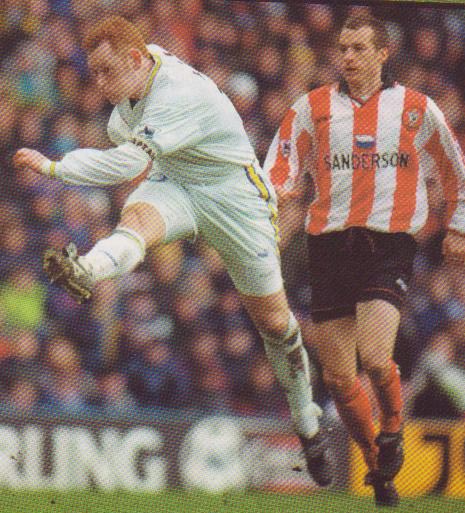
Ginger-haired Hopkins started with Port of Glasgow Boys Club before joining his hometown
team Morton in July 1989. He had a trial with Sheffield United in 1991 but after scoring
seven goals in fifty-two games, comprising four goals in thirty-three starts and fifteen
games from the bench in the Scottish League, one goal in two starts in the Scottish Cup
and two goals in two starts in the Scottish League Cup, he left Morton for Chelsea at a fee
of £300,000 on 25th September 1992. In almost three years at Stamford Bridge he scored once
in forty-six appearances without really establishing himself in the first team. Indeed, his
one goal was scored in the League, in which he made nineteen of his forty appearances as a
substitute and two of his five F.A. Cup appearances were from the bench, as was his only
League Cup appearance. Conspicuous by his tattoos and shock of red hair, Hopkin made an
impressive debut in a 0-0 draw with Liverpool on 10th February 1993, one of few impressive
performers in a truly dire match. Not surprisingly he kept his place for the following
weekend's visit of Aston Villa, but Chelsea lost, manager Ian Porterfield was sacked and
his caretaker replacement, David Webb, surprisingly opted to replace him with the woefully
out-of-form Robert Fleck on the right wing, selecting Hopkin for just two substitute
appearances in the final three months of the season. He fared little better under new
manager Glenn Hoddle when the former England man took over that summer, not helpedby the
fact that Hoddle preferred a three-five-two formation with the full backs pushed on as
wing-backs. Hopkin was given his first opportunity to impress when he replaced the
suspended Dennis Wise for a trip to Aston Villa but was immediately dropped after a 1-0
defeat that continued a disappointing start to what was a poor league campaign. He was
given further opportunities either side of Christmas but, in line with the vast majority of
the team, he was regularly out-of-sorts and only rarely showed glimpses of what he was
capable of. Perhaps his most significant moment in a Chelsea shirt came when he crossed
for Gavin Peacock to score the goal against Wolves which took Chelsea into their first FA
Cup semi-final for twenty-four years but by the time the final came around, Hopkin was on
the sidelines. There was little change in his fortunes the following season. Hoddle signed
David Rocastle just prior to the start of the season, putting another obstacle in Hoppy's
way, and it wasn't until late October that he resurfaced in the first-team. There was
further frustration in the fact that a FIFA ruling meant that he was considered a foreign
player and he was therefore not selected for any of Chelsea's European Cup Winners Cup
matches as the Blues made it to the semi-finals. He did, however, benefit in part from the
European run as he found himself being recalled to the squad for the weekend matches
following the European ties as Hoddle looked to rest players. He scored his only goal for
the club with a header in a 3-3 draw at Everton in May but it was little more than a
swansong. Sporadic appearances were barely adequate for a man who had travelled south in
the hope of making a name for himself and he played his last game for the club in a 2-1
victory over Arsenal on the final day of the season before joining Crystal Palace on 29th
July 1995 for £850,000 and going on to perform well at the highest level for both club and
country. He starred on the Eagles' right-flank for two seasons in the mid 1990s making an
important contribution to Palace's progress. Strong running and possessing a prodigious
long throw-in, Hopkin was a huge asset to the club's cause and had a flair for scoring
spectacular goals. This talent was never better demonstrated than in the 1997 play-offs.
For the second year in a row Palace only needed a win at Wembley to win promotion to the
Premiership and David produced a fantastic moment in Palace history that supporters will
always remember him for. With the match against Sheffield United scoreless and with only a
minute to go until full-time Palace won a corner that was headed clear to him, twenty yards
from goal. He controlled the ball with his left foot before curling an unstoppable shot
past Simon Tracey in the Blades goal much to the delight of the 30,000 or so Eagles fans
present. Hopkin won the club “Player of the Year” and was awarded full international
honours for Scotland in 1997 but to the disappointment of everybody at Selhurst Park he
moved to Leeds United on 21st July 1997 for a fee of £3.25million. He had scored thirty
goals in ninety-nine appearances in his first spell with Palace. He scored twenty-one
League goals in eighty-three games of which just four were from the bench. There were no
goals in the F.A. Cup from three starts, but he scored six times in six League Cup starts
and three times in seven starts in play-offs and other games. Hopkin was called up by his
country for the first time on 1st June 1997 for a 3-2 win over Malta in Ta Qali, when he
started but was replaced by Scot Gemmell after fifty-six minutes. He added a second a week
later when he was again a starter in Minsk in a World Cup qualifier when Scotland beat
Belarus by the only goal of the game from Gary McAllister, but again he was substituted by
Scot Gemmill after sixty-eight minutes. After joining Leeds he remained a Scotland squad
regular until injuries interevened. He was a major contributor to a fine Scottish victory
in the return leg with Belarus at Pittodrie, Aberdeen on 7th September 1997. Coming on as a
fiftieth minute replacement for Gary McAllister, he scored the third and fourth Scottish
goals in the fifty-fourth and eighty-eighth minutes as Scotland cruised to a 4-1 win. His
fourth cap came as an eighty-ninth minute substitute for Gordon Durie in a 1-2 loss to
France at St Etienne on 12th November 1997. He was selected for Scotland "B" at Tynecastle
Park, Edinburgh on 21st April 1998, his only appearance at that level. There was a full game
for his fifth cap as Scotland defeated Czechoslovakia in a European Championship Qualifier
at Parkhead on 31st March 1999. In the same competition there was another full game in
Sarajevo as Scotland beat Bosnia and Herzegovina by 2-1 on 4th September 1999. His seventh
and final full Scotland cap came in the reverse leg against the same country at Ibrox on
5th October 1999, when he played a full game as the home side ran out 1-0 winners. He was a
key part of Leeds hopes and plans for the future under George Graham. He knew how to find
the goal as well as being a dominating force in the middle of the park. There was also a
strong expectation from the fans, who had seen him outplay Lee Bowyer when the two clubs had
met in the League Cup in the previous season. With strong competition for the midfield
places, and with George Graham occasionally playing tactics that completely bypassed the
middle of the park, Hopkin did not figured as strongly as he would have hoped in 1997-98
season, missing a couple of games through illness and suspension and often being replaced by
substitutes later in the game. In 1998-99, he became a regular in the starting line-up, but
there was still stiff competition for places and continued speculation about signings. His
scoring record dropped off somewhat and though he had an excellent rate at Palace, it was a
lot less prolific for Leeds. Under David O'Leary, he was in and out of the midfield at the
start of the 1999-2000 season before an operation which kept him out for nearly two months.
The fact that he could barely make it onto the bench when he returned, even with David Batty
absent, told him he was no really part of O’Leary’s plans, and after talk about a move away
from Elland Road on 7th July 2000 he went to Bradford City for £2.5million. Injury ravaged
his time at Valley Parade and he only played sixteen games without scoring. There were only
eight League starts and three more from the bench and just one start in the League Cup, while
he did start three, and came of the bench once, as City contested the Inter-Toto Cup at the
beginning of the pre-season. On 15th March 2001 he returned to London, for £1.5million, to
help keep Crystal Palace in Division One. He returned to something of his old self, albeit in
a lower division. His form was one of the major factors in the club avoiding relegation to the
Second Division that season. After scoring four times in thirty-one games in his second spell
at the club, all four goals coming in the League, in which he started twenty-one and was used
as a substitute eight times to add to his one start in the F.A. Cup and one substitute
appearance in the League Cup, he was released by Palace on 31st August 2002 and returned to
Morton on a free transfer. After scoring twice, once in the Scottish League and once in the
Scottish League Cup in six Starts in the League and one in the League Cup, he retired on 14th
November 2002 due to a recurring ankle injury. Hopkin and Derek Collins had a brief spell as
joint caretaker manager at Morton when they occupied the dugout for a match against Albion
Rovers. Hopkin made one appearance, against Berwick Rangers, as a seventy-sixth minute
substituteon 4th October 2003 but it was his last. He became Assistant Manager at Port Glasgow
FC. He owned the Gift Box Newsagents in Greenock and did a bit of coaching at Port Glasgow Boys
Club. Hopkin won seven caps for Scotland and scored twice, he also played for Scotland “B” once.