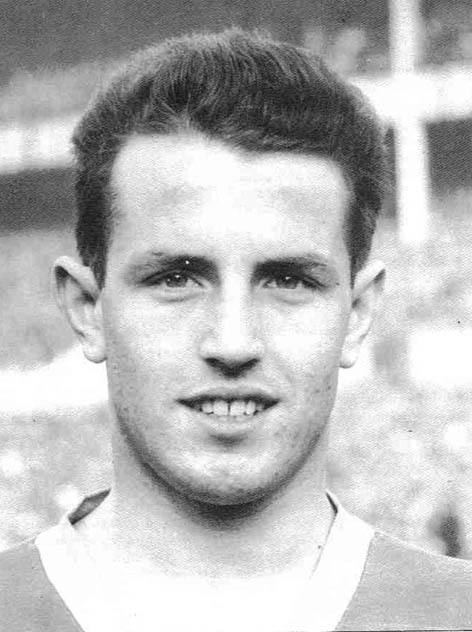
Humphries: William McCauley (Billy)
1958-1959
(Player Details)
Outside Right
Born: Belfast: 08-06-1936
Debut: Arsenal (h): 27-09-1958
5’4 1/2” 9st 12lb (1959)
At school Humphries was a rugby scrum half, but also shone as a soccer player.After
starting as an amateur with East Belfast while working as a clerical officer with the
Belfast Transport Department. He spent four years at Glentoran, as an amateur, scoring four
goals in twelve appearances during the disastrous 1954-55 season. He signed for Ards,
against who he had scored on his Glentoran debut the previous January, in the summer of
1955. He made his Ards debut on 24th August 1955 in an Ulster Cup tie with Glenavon. Two
years later, under the stewardship of the legendary George Eastham, Ards claimed their
first, and to-date only, Irish League title, Humphries playing a key role. He was selected
for the Ireland Amateur team and played three times, against Wales in 1956-57 and against
England in that season and in 1957-58. The 1957-58 season also brought Humphries his first
major representative honour as he played for the Irish League, in a 7-0 defeat by the
Scottish League at Ibrox, on 9th October 1957. Early the following season on 4th September
1958, Humphries was on the end of another Inter-League debacle, the Scots coming to Windsor
Park to win 5-0. He also featured in Ards’ first European match, French champions Stade de
Rheims coming to Windsor Park and triumphing 4-1 thanks to four goals by that year’s World
Cup star, Just Fontaine. Before thesecond leg in Paris, Humphries had departed Ards to sign
for Leeds United in a £5,000 deal in September 1958. Blackpool had seemed the likely
destination until the very last moment, when Leeds stepped in. The Yorkshire club were the
first to recognise the talent of Billy Humphries, but unfortunately did not reap the benefits
of his skill. He lasted a little over a year at Elland Road, scoring twice and playing
twenty-five times in the League and once in the F.A. Cup, for the struggling First Division
team. The twenty-two-year-old did not settle at Leeds and he returned to Ards in November
1959 and gained a runners-up medal in the Irish Cup. It didn’t take long for Humphries to
regain his form and in the 1961/62 season he played in all four of the Irish League’s
representative matches, in the 7-0 drubbing by the Scottish League on 4th October 1961,
followed by a 6-1 defeat by the Football League on 1st November 1961 in Belfast, 3-1 win
over the League of Ireland in Belfast on 4th April 1962 and the most notably in a 6-2 victory
over the Italian Semi-Pro League at Windsor Park. On 11th April 1962 he won his first cap for
Northern Ireland, as stand-in for Billy Bingham on the right-wing. It wasn’t a happy match for
the Irish, they lost 4-0 to Wales at Ninian Park Cardiff, but it did bring Humphries back to
the attentions of a mainland club. A week after the Cardiff match, he signed for Coventry City
in a £14,000 transfer, and made his Football League return in a Division Three match against
Hull on 28th April 1962. By the end of the season Humphries had won his second cap, and again
Northern Ireland lost 4-0, this time to the Dutch at Feyenoord Stadium, Rotterdam on 9th May
1962. Over the following few seasons, Humphries established himself on the international scene,
taking over the number seven shirt from Billy Bingham who moved to the left-wing. On 10th
October 1962 he scored in Northern Ireland’s first ever European Nations Cup (now the European
Championship) match, a 2-0 win over Poland, in Katowice, with Derek Dougan getting the other.
As the Northern Ireland forward-line evolved to facilitate new players, Humphries found himself
employed at inside-right, with Bingham outside him. Later he would have to make way himself for
new talent, the likes of Best, McLaughlin, Dougan, Irvine and Wilson forcing Humphries out of
the international reckoning before he was thirty. On the domestic front things were looking
up and he was linked with a move to top-flight football. Humphries scored ten times as
Coventry won the Third Division title in 1964 under the leadership of Jimmy Hill. He scored
twenty-three goals and made a hundred and nine League appearances, twelve F.A. Cup
appearances and scored one goal in five League Cup appearances for the Sky Blues before a
£14,000 move took him to Swansea Town. There he made a hundred and forty-three League
appearances and scored twenty-two goals. He also scored four times in eight F.A. Cup games
and played six League Cup games without scoring. Immediately popular with the Swans fans,
Humphries could do nothing to save the club from relegation from the Second Division in 1965,
and by 1967 hefound himself playing in the Fourth Division. The highlight of Humphries’ Swans
career was no doubt the 1966 Welsh Cup Final victory over Chester. In June 1968, just turned
thirty-twoyears of age, Humphries’ Football League career was ended when he was released by
Swansea. In the summer of 1968 he returned to Ireland for a third, and longest, spell with
Ards. He played five hundred and seventy-one times for Ards and scored one hundred and
thirty-eight goals in domestic games and started seven games for them in European competition.
George Eastham jumped at the chance to bring one of Ards’ all-time favourites back to
Castlereagh Park. His first season back in the Irish League brought an Irish Cup win.
Distillery were defeated 4-2 in a replayed final at Windsor Park. In 1969 he played in a
famous 0-0 draw with Roma at the Oval in the Cup Winners’ Cup. 1970 brought him the title of
Ulster Player of the Year, as well as Ards Player of the Year and his appointment as Ards
player-manager. In 1972 he led the club to a Co. Antrim Shield success and at thirty-five won
both the Ulster Footballer of the Year and Northern Ireland Football Writers’ Player of the
Year awards. The pinnacle of Humphries long association with Ards arrived in 1974 when he led
them to four trophies - the Irish Cup, Ulster Cup, Gold Cup and Blaxnit Cup. It was Ards most
successful season in their history. Humphries retired as a player in 1976, just before his
fortieth birthday, but continued to serve Ards as Manager until 1978, and again from 1980 to
1982. He was also a club Director and Manager of the social club until dismissed in 1982. Later
Humphries had a spell as Manager of Ards’ local rivals Bangor from 1983 to April 1985. As well
as gaining fourteen caps for Northern Ireland and scoring once, he represented the Irish League
twelve times and played for an Irish FA Representative XI as well as gaining three amateur caps
for Northern Ireland. He ran a newsagent shop until his retirement in 1991.