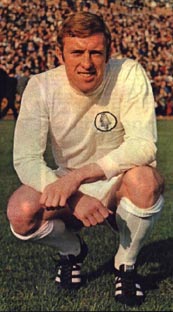
Jones: Michael David (Mick)
1967-1975
(Player Details)
Centre Forward
Born: Worksop: 24-04-1945
Debut: v Leicester City (h): 23-09-1967
5’10” 11st 9lb (1969)
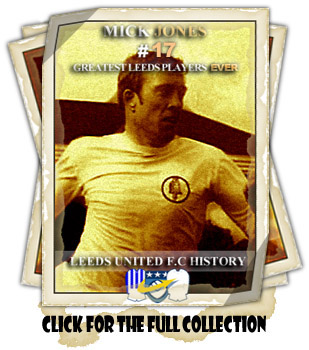
#17 in 100 Greatest LUFC Players Ever
Jones’ father kept goal for Worksop, but his son soon developed the knack of scoring goals
and once hit fourteen in a game for Priory Primary School. He played for Worksop Boys and
Rotherham Boys and began work in a cycle factory while playing for Dinnington Miners’
Welfare. He as invited to train with Sheffield United Juniors and joined the groundstaff
in March 1961. He signed for professional forms for Sheffield United in November 1962. He
graduated from the intermediate side through the Central League side before making his debut
in a 1–1 draw against Manchester United at Old Trafford on 20th April 1963. He scored his
first two league goals in the next fixture, a 3–1 victory against Manchester City at Maine
Road four days later. He was capped at Under-Twenty-three level, scoring the opening goal in
the fifty-seventh minute which paved the way for a 5-0 victory over Romania at Highfield
Road, Coventry, on 25th November 1964 in a game which featured Norman Hunter at Left-Half.
He was retained for the 0-0 draw with Scotland at Pittodrie Park, Aberdeen on 24th February
1965, when he had Paul Reaney and Norman Hunter as team mates and Billy Bremner as an
opponent. Neither of his future Leeds team mates were in the team when he won his third cap
at Elland Road on 7th April 1965 in another 0-0 draw with Czechoslovakia. There were no goals
from England again as they went down to West Germany 0-1 in Freiburg on 25th May 1965, when
he had Paul Reaney as company. His sixth cap produced another 0-0 draw, on 2nd June 1965,
against Austria in Vienna, with Paul Reaney as a team mate. On 30th April 1965 he had
represented Young England against England at Highbury on the day before Leeds were defeated
by Liverpool at Wembley. His sixth cap saw him score twice as England beat France 3-0 at
Carrow Road, Norwich, on 3rd November 1965, this time with Mike O'Grady on the left-wing, and
he was again on target as he opened the scoring in a 2-1 win over Yugoslavia at the Dell,
Southampton, on 24th November 1965. His eighth and penultimate appearance at Under-Twenty-Three
level was in a 2-0 win over Turkey at Ewood Park, Blackburn, on 20th April 1966. By then he had
played twice for the full England team in 1965, with Jack Charlton as a team mate in both games,
making his debut in a 1-0 win against West Germany on 12th May 1965 in Nuremberg, when he was
only twenty, and just four days later he played against Sweden in Gothenburg, where England won
2-1, but Jones did not score in either game, although he did have a hand in Terry Paine's goal
against West Germany and generally gave a good account of himself in that game but was not at
his best in the second game. Alf Ramsey was, at that point, undecided about his strikers for
the forthcoming World Cup and as well as Jones, he gave chances to United's Alan Peacock, Barry
Bridges of Chelsea and Joe Baker of Arsenal and after being included in his squad of
twenty-eight, he was one of those to miss out as Ramsey culled his squad to twenty-two. Geoff
Hurst, who was not called up until late, and Roger Hunt and Jimmy Greaves were left to fight
out for Alf Ramsey's favour in the World Cup Finals. His final Under-Twenty-Three's appearance
came on 10th May 1967 at Boothferry Park, Hull, and it saw his first pairing Allan Clarke, then
of Fulham, a pairing which was to prove devastating for many years to come.Neither scored in a
3-0 victory over Austria, but they spearheaded a fine England performance. Jones was on the
rise with Sheffield United, who were starting to look at the top places rather than the bottom
ones, while Leeds Manager Don Revie was resigned to the fact that Alan Peacock would not
overcome his injury problems and that his other options did not provide him with the firepower
he needed. Jones was not the finished product, but Revie saw that, with the right coaching, he
could become it. In his time at Bramall Lane he scored seventy-six goals in one hundred and
seventy-two games. Sixty-three goals came in one hundred and forty-nine League games, nine in
eleven F.A. Cup ties, one in seven League Cup games and three goals in five other matches. He
became Leeds’ first-ever £100,000 player on 22nd September 1967 and the signing of Clarke two
years later gave Jones the perfect partner. Three England caps and nine Under-Twenty-Three
appearances were scant reward for all the effort Mick Jones put into the game, particularly
with Leeds. His partnership with Allan Clarke was a deadly formation yet was never tried at
full International level. The pair’s contrasting styles, Jones’ aggressive non-stop strong
running and Clarke’s delicate skills, proved an outstanding attacking combination. Possessed
of an innate ability to simply hold a ball, more often than not with his back to the goal,
until support from team mates arrived, which enabled defence to turn readily to attack. He
was the original, definitive "target man". He was always in the thick of the action and
although he took the brunt of what the defensive strongmen had to offer, he was never one to
feign injury, exaggerate injury or retaliate. To add to this he also scored some exciting
individual goals. He would have been priceless in the modern game. Leeds manager Don Revie
handed Jones the number nine shirt and told him to score goals and annoy defenders. Jones
went on to do just that with aplomb and authority for seven years. Leeds won the League Cup
in his first season, although Jones did not feature in the campaign because he was cup-tied,
and the Inter-Cities Fairs Cup, with Jones scoring twice during the competition. The following
season Leeds won the League Championship with Jones settling into the highest level of club
football with fourteen goals. However, Revie was aware that he needed more help with the
finishing up front, and in summer 1969 he paid another six-figure sum for Leicester City
striker Allan Clarke to begin one of football's most feared strike partnerships. Jones, the
more bruising of the two, often scored goals through individual runs using his burlier frame,
and was brave enough to put his head among the flying boots to get goals of courage. Clarke
was more reliant on guile and positional sense. Together they were a nightmare for central
defenders as Leeds stormed towards a possible "treble" of League title, FA Cup and European
Cup. Everton edged out Leeds for the League title, and Celtic beat them in the European Cup
semi-finals. In the FA Cup final against Chelsea Jones was to the fore as Leeds tried to
salvage something from their season. At Wembley, the game was locked at 1–1 on a bumpy, sandy
pitch (due to the “Horse of the Year” show being held there the previous week) with fewer
than ten minutes to play. Leeds attacked down the right flank with Johnny Giles crossing for
Clarke to plant a meaty header past Chelsea goalkeeper Peter Bonetti. The ball rebounded off
the post, evading Leeds striker Peter Lorimer who was following up. Jones, who had dropped
deep to start the move, was still jogging towards the area when he saw the ball trundle
towards him, and he fired a left foot shot into the net beyond Bonetti's despairing reach.
Usually goals scored so late in a Cup Final would emerge as the clincher. Chelsea, however,
equalised quickly due to poor marking in the Leeds defence and so the game went to a replay
at Old Trafford. Leeds took the lead in the first half, when a superb run by Allan Clarke set
Jones on his way towards goal, and he smashed a terrific right foot shot past Bonetti.
Chelsea, however, ended up winning after extra time and Leeds ended the season without a
trophy to show for all their endeavours. On a personal note, Jones had been recalled by
England for their game with Holland at Wembley on 14th January 1970, which ended as a 0-0
draw, even though Leeds had four players in the starting eleven, but it was a false dawn as
it was his last Cap for England. Terry Cooper, Jack Charlton and Norman Hunter were the other
three Leeds players that day. A last-day win for Arsenal cost Leeds the title again 1971 but
in 1972 some success finally came Leeds' way, though the season still had personal triumphs
and tribulations for Jones. He had many great matches for Leeds United, but perhaps the best
was the fifteen-minute hat-trick against Manchester United. It happened on 19th February 1972
with Jones having been sidelined with flu, he was recalled to the team after missing the
previous game at Everton with Leeds having lost only once since 13th November1971 and
Manchester had not won since 4th December 1971 on the back of a five match losing spell,
which had seen them go from top of the League, with a lead over Leeds of five points, to
being two points second placed Leeds in fifth spot. It seemed that the Lancastrians were
like pigs ready for slaughter. And so it was that Leeds were just the team to do it. More by
luck than good judgement the Salford team hung on to keep a clean sheet at half-time, thanks
to heroics by their keeper Alex Stepney. The teams had not long returned to the field when
Jones broke the deadlock after Stepney had pushed an Eddie Gray shot on to the post to leave
the quick reacting Jones with an easy task of putting the ball in the net from close range.
Allan Clarke scored seven minutes later but Francis Burns brought the deficit back to one
soon after. It took Jones just one minute to restore United's two goal lead as he scored with
a typical header from a Billy Bremner cross. The hat-trick, Jones' first in the League, was
completed in the sixty-second minute as Jones made it 4-1 and he then turned provider in the
seventy-fourth minute to complete the demolition as the crowd chanted "Easy, Easy". While
challenging for the title again, Leeds also made it to another F.A. Cup final and, still to
win the competition, went up against holders Arsenal as second favourites. But they won 1–0,
with Jones setting up Clarke for the only goal of the game, his fine cross on the turn from
the byline was headed home by his strike partner. However, Jones suffered an appallingly
dislocated elbow in the last minute of the game after landing awkwardly from an innocuous and
accidental clash with the Arsenal goalkeeper, Geoff Barnett,while chasing a lost cause. Jones
was unable to celebrate Leeds' success moments later when the final whistle sounded as he was
in agony, receiving treatment from the club physiotherapist. He was in so much pain that he
had to be helped, very slowly and gingerly, up to the Royal box to collect his medal, several
minutes after his team-mates had done so. Leeds' central defender Norman Hunter guided Jones
up the steps. Jones, his damaged limb in a tight, delicate sling, received his medal and
immediately handed it to Hunter so he could use his only available hand to hold the bannister
and guide his way back down the steps again. He was then placed on a stretcher, from which he
waved to the Leeds supporters as he was taken to the dressing room for treatment. Hunter
afterwards claimed that the striker's enforced absence for the League title decider against
Wolverhampton Wanderers, a few days later, cost Leeds the championship. Leeds lost 2–1 and
the title went to Derby County. Jones played in two finals the following year, both of which
Leeds again lost. The 1–0 defeat to Sunderland in the FA Cup final was notable for its shock
value (Leeds were unbackable odds-on favourites and Sunderland were a Second Division side)
and Jones is best remembered for prematurely celebrating a goal by Peter Lorimer which had
not, in fact, crossed the line owing to a phenomenal save by goalkeeper Jim Montgomery which
he had not been expected to make. Leeds subsequently lost the European Cup-Winners Cup Final
to AC Milan by the same score-line. In an astonishing twenty-nine-match unbeaten run at the
start of the next season, Jones bagged fourteen goals as Leeds coasted to the title. He was
voted Leeds player of the year in 1973-74, but there was a price to be paid for all his
efforts in gaining his second championship medal. After scoring some vital early season goals,
as Leeds embarked on their twenty-nine game unbeaten run, he had picked up a knee injury in
training as Leeds were on their run-in to the title and he played through the pain barrier in
games in which he would not normally have played. On 9th February 1974 he had set Leeds on the
way to a 2-0 win at Old Trafford, with what proved to be his final goal for United. He did
make three substitute appearances as United slumped temporarily in their Championship quest
in late March, before he made his final sacrifice by playin three consecutive games over
Easter as United picked up a draw 0-0 at home to Sheffield United, won the return at Bramall
Lane 2-0 and then virtually clinched the title with a 3-2 win over Ipswich Town at Elland
Road. Throughout his career Jones had struggled with injuries and it was this serious knee
injury that ended his career in October 1975. After the title win in 1974, he had tried to
rest during the summer to sort out his knee problem, but an operation was required, as the
bone under the kneecap had flaked away and his rehabilitation involved serious physiotherapy
and daily trips to St James' Hospital. By February 1975 he had reached a plateau and the
medics gave him the go-ahead to resume light training. He played in a friendly match and also
turned out in a handful of reserve games, but during a Central League match at Anfield, the
end came. The knee was giving him considerable pain no matter what he did, and it was back to
the doctors. This time there was to be no recovery. With Joe Jordan in the number nine shirt
and scoring frequently, and the team (despite Revie's departure in the summer to take over
the England job) reached its first European Cup final. Jones was a dejected spectator who
didn't figure in the team at all that season. He watched disconsolately as Leeds lost the
European Cup final to Bayern Munich and then retired at the age of thirty, unable to beat his
knee problem. Jones fell on hard times after retiring back to Worksop but eventually began
selling sports equipment on market stalls. He also worked in the pub business. He later ran
a sports shop in Maltby and now lives in Worksop and sells sports wear in Nottingham.