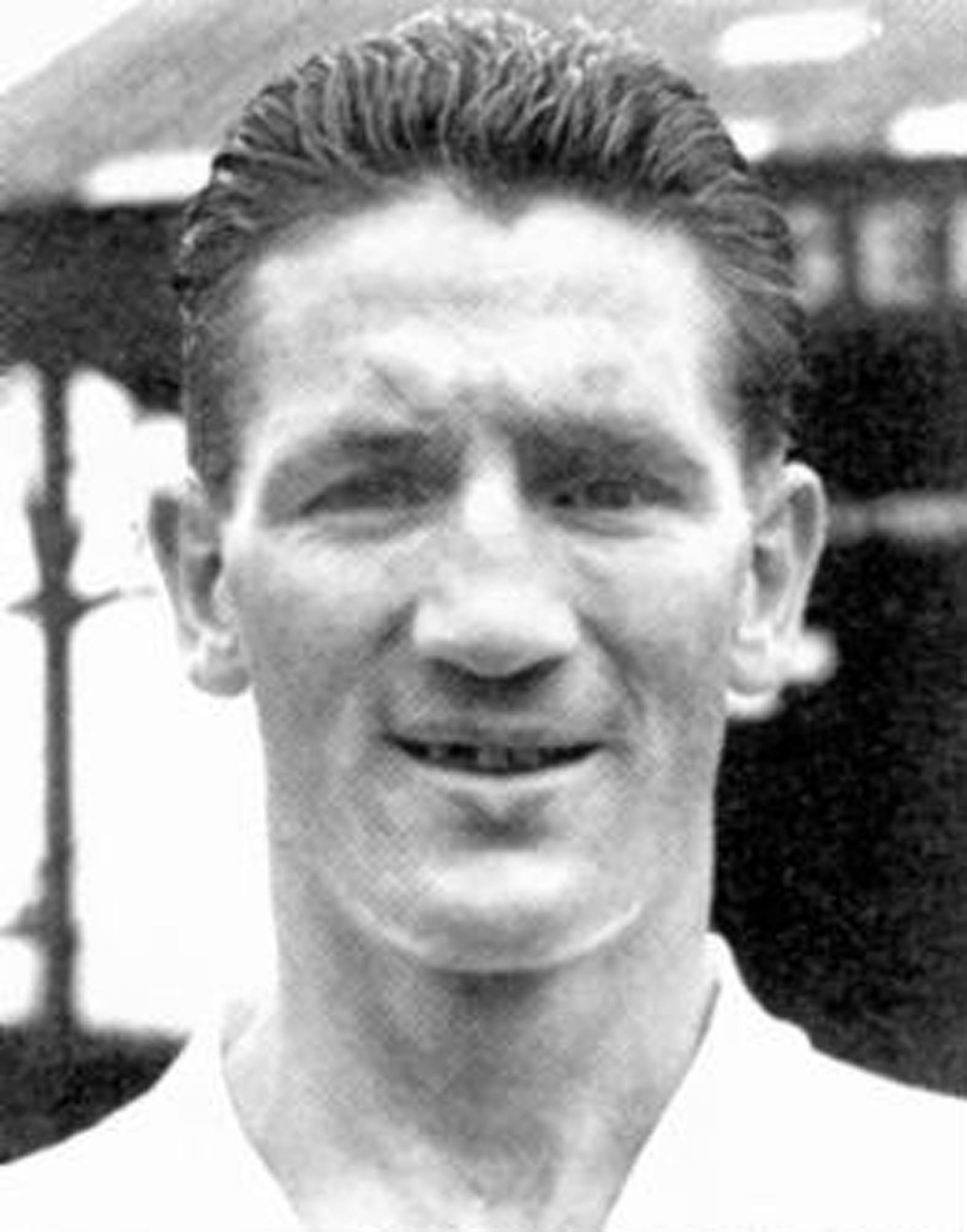
McAdams: William John (Billy)
1961-1962
(Player Details)
Centre Forward
Born: Belfast: 20-01-1934
Debut: v Charlton Athletic (a): 16-12-1961
5’9 1/2” 11st 7lb (1959)
A product of Grosvenor Secondary School, Belfast, he worked as an apprentice heating
engineer and played as an amateur for Bainbridge Town and Glenavon. He had a three month
trial with Burnley in 1952 but did not join them as his father thought he was not offered
enough. His father was Sam 'Bull' McAdam, Distillery's all-time topscorer and young Billy
inherited his father's knack of finding the net. So he returned to Ireland and signed
professional for Distillery at the age of seventeen. He won a County Antrim Shield runners’
up medal and scored twenty-two goals in forty appearances. His performances for Irish League
side alerted English clubs. George Hardwick, Manager of Oldham Athletic put in an offer for
his services but his Directors would not go high enough and Manchester City upped their bid
and signed him in December 1953 for £10,000. Just nineteen when he joined City, McAdams hit
the ground running with a debut goal against Sunderland, City's first, in a 2-1 win at Maine
Road on 2nd January 1954. He followed this with a hat-trick in his second game, a 5-2 Third
Round F.A. Cup win at Bradford Park Avenue on 9th January and then got City's goal in a 1-1
Manchester "Derby" draw at Old Trafford on 16th January. By the end of the 1953-54 season he
had hit eleven League and Cup goals in nineteen appearances and also appearing in his first
international, a 2-1 win over Wales in Wrexham. That match was regarded as a watershed for
the Irish national team as Harry Gregg, Jackie Blanchflower and Peter McParland, who scored
both the goals, made their debuts and the basis of Peter Doherty's great side had been
founded. He scored his first International goal in his second appearance for Northern
Ireland in a 2-2 draw with Scotland at Hampden. Sadly McAdams' role in the great successes
of the 1950s was to be limited by injury. He missed an FA Cup Final with City because of a
slipped disc, playing only nineteen games abs scoring six goals in the 1954-55 season. He
missed almost two seasons and was told he would not play again, but he fought back well
enough to score four goals in fourteen games for City in the 1956-57 season and established
himself once more in the Northern Ireland side, with three appearances in a year, all at
Windsor Park, against England on 6th October 1956 in a 1-1 draw, on 5th October 1957 in a
1-1 draw with Scotland and on 4th December 1957 in a 2-2 draw with Italy. Although
undoubtedly skilful, McAdams' greatest asset was his bustling style and willingness to get
"stuck-in" though this made knocks inevitable. Further, he was plagued by continuing back
problems throughout his career. When fit, as he was for only twenty-eight games of the
1957-58 season during which he scored nineteen times, McAdams was among the most feared
strikers in the English game. In that campaign he scored ten goals in ten consecutive First
Division matches. It was a record matched only once and never bettered in any division of
the Football League. Sadly illness, injury and club commitments meant he was not a part of
the Northern Ireland side that qualified for and excelled at the 1958 World Cup. The only
match that he played in was the "down-graded" match against Italy, the infamous "Battle of
Belfast". He was a regular marksman until his £15,000 transfer to Bolton Wanderers in
September 1960. He scored four in twenty-three appearances in 1958-59 and scored twenty-two
in thirty-one games in 1959-60 before playing his final game for City in a 2-1 win over
Preston North End at Maine Road on 23rd April 1960. In his time at Maine Road he scored
sixty-two goals in one hundred and twenty-seven appearances in the League and a further
three in seven games in the FA Cup. As a Bolton player his International career flourished
as he scored both goals in a 2-5 home defeat by England on 8th October 1960 and then he
scored a hat-trick against West Germany in a World Cup qualifying game, but still ended up
on the losing side as Northern Ireland went down 3-4 at Windsor Park on 26th October 1960.
His eighth and ninth caps both saw heavy defeats as Northern Ireland went down 2-5 to
Scotland at Hampden Park on 9th November 1960 and Wales by 1-5 at Windsor Park on 12th
April 1961. His seventh International goal duly arrived in a 2-3 defeat by Italy in Bologna
on 25th April 1961 in his tenth International appearance, and this was followed by three
more appearances, this time in the World Cup qualifiers as Northern Ireland were beaten
1-2 by Greece in Athens on 3rd May 1961 and West Germany, by the same score in Berlin a
week later, before they took revenge on Greece with a 2-0 win on 17th October 1961. He took
his caps to fourteen in a 1-1 draw with England at Wembley on 22nd November 1961. He was
seen as a natural successor to Nat Lofthouse at Burnden Park and in his first season he
fulfilled all their hopes with eighteen goals in twenty-seven appearances. He maintained
his good scoring record with the Trotters, managing twenty-six goals in forty-four League
appearances and three more goals in eight games in the Cup competitions. When his former
Manchester City colleague, Don Revie, stepped in with a £12,000 bid to take him to Leeds
United in December 1961 to spearhead their promotion bid, Bolton accepted with glee. The
move never really worked out for either party as the same old problems emerged. During his
seven month stay at Elland Road, McAdams did claim his fifteenth and final cap in a 0-4
defeat by the Netherlands in Rotterdam on 9th May 1962. He had managed a respectable seven
goals in fifteen appearances, at International level. However, he soon moved on, joining
Brentford for £8,000 in July 1962. He won a Fourth Division medal with the Bees in 1962-63
again living up to his goalscoring reputation with thirty-six goals in seventy-five League
appearances supplemented by another three goals in twelve games in the Cups, while at
Griffin Park. He then joined Queens Park Rangers for £5,000 in September 1964 for whom he
scored eleven goals in thirty-three League games and one more in five Cup games in another
injury-ridden stay. It was a move to Barrow in 1966 that perhaps proved McAdams happiest move,
as it was in Barrow-in-Furness that he settled when his career was over. Barrow Manager Don
McEvoy brought in several new faces including Billy McAdams, Fred Else and Eric Harrison, all
of whom were to play a major part in what proved to be a memorable season. Records were broken
regularly. The club gained more away wins than any other side in the Football League, they had
a spell at the top of the Fourth Division, reached the final of the Lancashire Senior Cup for
the second year running and reached the Third round of the F.A. Cup. The highlight of the
season without doubt was the fact that the club finished in third place in Division Four,
which assured promotion to the Third Division for the first time. He made his Bluebirds debut
in a 1-1 draw with Stockport County on 20th August 1966 and scored his first goal for the club
the following Saturday in a 3-1 win over Rochdale. In all he scored nine League goals the club
claimed promotion to Division Three. Perhaps his greatest goal in Barrow-colours was reserved
for the visit of Southampton in the FA Cup third round, a screamer in a 2-2 draw infront of a
15,000 crowd. In his two seasons there he scored nine times in fifty-three League games and
three times in nine cup-ties. McAdams retired from the professional game in 1968 as one of
Northern Ireland's most prolific goalscorers in the Football League. After the 1967-68 season
he went into Non-League football with Netherfield. He scored seven times for Northern Ireland
in fifteen games and one hundred and eighty-two times in four hundred and twenty-six games in
non-international football. Outside of football McAdams was a keen golfer and also
accomplished on the bowling green. He remained a frequent visitor to Belfast even after he
was struck-down by ME in the 1990s. He was afforded a benefit match between Barrow and a
Manchester City XI in July 1993, as well as help from the PFA to supplement his invalidity
benefit. He died on 13th October 2002, in Barrow-in-Furness, aged sixty-eight following a
short battle with cancer.