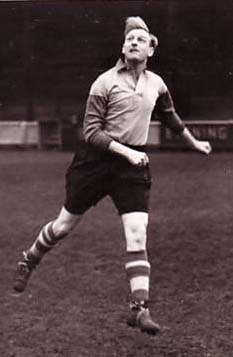
McCabe: James Joseph (Jim)
1948-1954
(Player Details)
Half Back
Born: Draperstown, Co. Londonderry: 17-09-1918
Debut: v Bradford Park Avenue (a): 13-03-1948
5’10” 11st 10lb (1951)
Born in Draperstown, Jimmy McCabe's family moved to the South Bank area of Middlesbrough
when he was a youngster. He began playing football with local side South Bank St Peter’s, a
team based round the local Catholic Church, which also gave the game Wilf Mannion. McCabe
filled various positions but was at his best at wing-half. He played for Billingham
Synthonia Juniors and then South Bank East End, before signing for Middlesborough in May
1937, but he had to wait until after the Second World War to make his debut. After Wartime
service along with Wilf Mannion with the Green Howards, in France and the Middle East, and
attaining the rank of sergeant, he resumed his career at Ayresome Park. The brilliant
England International and McCabe had grown up together and had a long friendship which saw
McCabe become best man at Mannion's wedding. McCabe quickly became noted as a gifted
wing-half with real footballing quality, and able to perform with ease on either the left
or right. Due to war service he played little football in the war years but managed two
games in 1940-41, one goal in seventeen games in 1941-42, one game in 1944-45 and nine
games in 1945-46 for Middlesbrough, and one game for Millwall in 1941-42. After the war he
staked his claim for a regular first team place at Ayresome Park, making his debut in a 2-2
home draw with Liverpool on 9th October 1946 and he accumulated thirty-four appearances in
the League and another eight in the F.A. Cup before he played his final game for Boro in a
0-0 home draw with Chelsea on 6th March 1948 before foresaking Division One to join Second
Division Leeds United for £10,000 and Leeds also parted with goalkeeper John Hodgson,
valued at £4,000, in part-exchange. He went straight into the Leeds team at Bradford Park
Avenue on 13th March 1948, but he could not stop Leeds losing 1-3. Within months of joining
Leeds, McCabe won the first of six Irish caps, making his International debut on 17th
November 1948 in a 2-3 defeat by Scotland at Hampden Park. It was an omen for the rest of
his International career as he took part in six defeats in the green shirt. However, while
his International career, like so many other potential Internationals of that era was
restricted due to the Second World War, it still lasted for five years. His second cap duly
arrived on 9th March 1949 as Wales won 2-0 at Windsor Park, Belfast. His third was one to
forget as England hammered the Irish 9-2 at Maine Road, Manchester on 6th November 1949 in
a World Cup Qualifier, as Jack Rowley scored four and McCabe found himself at left-half
because Danny Blanchflower had claimed the number four shirt. Indeed, he made it his own and
it was more than a year before McCabe received his fourth cap and this time Wales won 2-1 at
Windsor Park, Belfast on 7th March 1951 in a home championship match and he played in his
preferred right-half position. His final two caps also came at Windsor Park, but the first
being in the unfamiliar right-back position, on 15th April 1953 as Wales again won, this
time by 3-2 in a home championship match, with ex-Leeds man Eddie McMorran getting both
Irish goals, while John Charles got a brace for Wales, and finally there was a 3-1 win for
Scotland on 3rd October 1953 in a World Cup Qualifying tie. He also took part in the 1953
Tour Of USA and Canada by the Northern Ireland F.A., but the games did not count as official
Internationals. He stayed just over six seasons at Elland Road and was part of a side which
consistently finished in the top-half of Division Two, without being able to make that push
to promotion. Initially it looked as though McCabe had been bought to replace stalwart
centre-half Tom Holley and his first games were in that position when Holley was injured,
quickly reverting to the left half position when the stopper was fit. In 1948-49 he was a
regular at wing half, alternating between left and right as required, but when Holley was
injured and his long career ended, he again took on the pivot role for three games before
the emergence of the young Welsh giant in the form of the great John Charles and McCabe
happily reverted to his favoured wing half role. In 1949-50 he featured solely at right half
as part of the McCabe-Charles-Burden half back line which saw United recover from a dismal
early start to play some brilliant football and soar up the Second Division and have their
then best FA Cup run ever before losing to the winners Arsenal in the Sixth Round at Highbury
1-0 and marginally fail to gain promotion in the fifth spot. Eric Kerfoot was starting to
emerge and forced his way into the team at the start of the 1950-51 season, but McCabe fought
his way back in and United solved the problem by reinstalling McCabe at right half, switching
Kerfoot to left half and pushing captain Tommy Burden up to the inside forward position. A
combination of injuries and the form of Kerfoot and Burden, saw McCabe restricted to a mere
fourteen games in 1951-52, mostly at centre-half as Charles also spent most of the season
sidelined by Army duty and injuries. The Kerfoot-Charles-Burden combination was together for
the first dozen games in the 1952-53 campaign but as Charles was pushed up in a striking role
McCabe was back in the first eleven at centre-half. Now well into his thirties, McCabe was in
the Kerfoot-McCabe-Burden half back line that started 1953-54 with Charles up front, but time
was catching up fast and with Jackie Marsden and Jack Charlton ready to step up McCabe left
Leeds in May 1954, joining non-League Peterborough. He made his debut in a 1 - 1 home draw
with Rotherham United Reserves on 21st August 1954 and score his first and only goal in a 2-0
home win over Mansfield Town Reserves on 11th April 1955. He played his final game in a 0-0
draw at Corby Town on 2nd May 1955 and had just the one season with the Posh scoring once in
thirty-one League appearances in the Midland League and also playing one F.A. Cup tie and two
friendlies before retiring at the end of the 1954-55 season. Later he returned to Teeside
where he worked in the chemical industry at ICI Wilton. He died in Cleveland in July 1989.