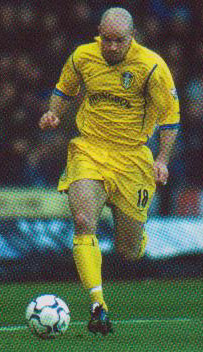
Mills: Daniel John (Danny)
1999-2004
(Leeds Player Details)(Player Details)
Right Back
Born: Norwich: 18-05-1977
Debut: v Derby County (h): 07-08-1999
5’10” 12st (2007)
#51 in 100 Greatest LUFC Players Ever
Mills attended Sprowston High School and was a product of Norwich City's School of
Excellence, signing for his hometown club in July 1993. Impressive in the Norwich youth team,
Mills won England Youth caps and was named as a substitute for the Premiership clash with
Everton in November 1994 whilst still seventeen. He made three appearances for the England
Under-Eighteens. His debut came in a 3-3 draw with Norway on 24th July 1994 at Larvik and two
days later he added a second in a 3-2 win over the same opposition at Vikersund when he came
on as a substitute for Graeme Power of Exeter City. His third came on 22nd February in a 5-6
loss to Denmark at Bescot Stadium, Walsall. He made his full debut for Norwich on 13th August
1995 against Luton Town, in which ex-Leeds defender, Jon Newsome, scored twice. At Norwich,
as in his future career, he appeared in a variety of roles in defence (right back, central
defender and occasionally on the left), his versatility attracted the attention of Charlton
manager Alan Curbishley who was picking a Nationwide League Under-Twenty-one side to play
against their Serie A counterparts. Mills captained this side. The transfer listed defender
was unhappy at the limited number of first team opportunities at Carrow Road and had sought a
transfer since December 1997. Gillingham and Millwall had expressed interest on taking Mills
on loan but Mike Walker sought a cash injection to fuel new squad additions prior to the
transfer deadline day. Mills joined then fellow First Division side Charlton Athletic for a
fee of £350,000 on 18th March 1998. While at Carrow Road Mills made sixty-six League
appearances, including twenty as a substitute and scored once. In cup competions he had two
FA Cup and five League Cup (including two as substitute) appearances and scored once in the
League Cup. Mills' arrival at The Valley coincided with a run of form that almost won them
automatic promotion into the Premiership. However, they had to settle for a play-off
semi-final against Ipswich which was won despite Mills being sent off in the first leg. He
played in the victory over Sunderland at Wembley that took Charlton into the Premiership.
He aimed a verbal blast at Carrow Road saying that he had proved them wrong by gaining
promotion. This victory was worth an extra £50,000 to City's bank balance. Charlton's
relegation on 16th May 1999 into Division One led to increased speculation that he would
depart from the Valley to fund the club's attempts to return to the top flight. He had now
progressed to the England Under-Twenty-One side, making his debut on 4th September 1998 in
a 2-0 win over Sweden in a Group Five UEFA Qualifier at Idrottsparken Sundsvall. By the time
he had signed for Leeds he had become a regular in the team and had six caps. he had added a
substitute appearance in a 1-0 win over Bulgaria at Upton Park, when he replaced Kieron Dyer
of Ipswich Town after sixty-three minutes on 9th October 1998, in another UEFA Qualifier,
followed four days later by a 5-0 win over Luxemburg in the same competition at Op Flohr,
Grevenmacher, Luxembourg. There was another 5-0 win on 26th March 1999 as Poland were beaten
in the same competition at the Dell, Southampton. His first International goal came in his
fifth appearance in a 2-2 in a friendly with Hungary at Stadion Albert Florian, Budapest in
the fifty-third minute on 27th April 1999. Huddersfield Town's McAlpine Stadium was the venue
of his sixth appearance, once more in the UEFA Qualifiers, as England defeated Sweden 3-0 on
4th June 1999. Leeds supposedly made a derisory £1million bid for him but Charlton held out
for four times that figure. Their hold-out was backed by his call-up on Sunday 6th June 1999
into the full England squad for the Euro 2000 clash with Bulgaria. Leeds persevered and
eventually won their man on 16th June 1999. Norwich City made almost £800,000 from the sale
as there was a twenty-five per cent sell-on clause from their sale on March 17th 1998. Mills
blasted his first club Norwich after completing his transfer to Leeds. "Norwich have got
double now what they got for me when I left and I'm showing a few people there what I can do.
Some people at Norwich were pleased to see the back of me because they didn't think I was
good enough and I'm delighted to prove them wrong. I've always had belief in myself and now
I'm playing for a top Premiership club. It took me a long time to get out of Norwich and when
I did a lot of people thought I wasn't good enough for the First Division. I'm glad they are
now eating humble pie". His move to Leeds ended an excellent season for him despite Charlton's
relegation. While at the Valley he scored three goals in forty-five League appearances. He aso
played once in the FA Cup, three times in the League Cup and twice in the play-offs. Mills had
joined Leeds on 16th June 1999 for approximately £4 million from relegated Charlton Athletic.
He initially found in hard to settle in Leeds and had been the subject of many a transfer
rumour in his initial months at Elland Road. Mills had found it hard to displace Gary Kelly
in the Leeds first team. Mills impressed in Leeds' Premiership season and in their impressive
European Champions League campaign against the likes of Barcelona, Lazio, AC Milan and Real
Madrid. In the meantime he maintained his place in the England Under-Twenty-One team and he
went on to add another eight caps to finish with fourteen at that level. Once more most of his
appearances were in the UEFA European Championships, with the first two in the Qualifiers with
a 5-0 win over Luxemburg at the Madejski Stadium, Reading, on 3rd September 1999 followed four
days later by his Captaining the team at the Stadion Orlen, Plock, Poland where he celebrated
with a goal thre minutes after half-time, but it didn't stop England going down 3-1 in the
Group Five match. He then played in two friendlies, the first, along with team mates Paul
Robinson, Lee Bowyer, Alan Smith and Michael Bridges and future team mate Seth Johnson in a
4-1 win over Denmark at Valley Parade on 8th October 1999, with Smith and Bowyer getting the
first two goals in the nineteenth and thirtieth minutes.The second friendly saw Mills start
the game in a 1-0 win over Argentina at Craven Cottage on 22nd February 2000 but gave way to
Luke Young of Charlton Athletic at half-time. His next game was on 29th March 2000 in a 3-0
victory against Yugoslavia at the European Championships play-off in Barcelona. He did not
start, but in an ill-tempered match, the Aston Villa midfielder, Lee Hendrie, was stretchered
off in the eighty-eighth minute in an unfortunate end to a satisfying day's work for England
and Mills was called upon to replace him, as England advanced to the Finals in Slovakia. His
final three caps came in Group B of those Finals, which were all played at Stadion Tehelne
pole, Bratislava, the first in a 0-2 defeat by Italy on 27th May 2000 and two days later he
weighed into a 6-0 win over Turkey by scoring in the seventy-seventh minute and he was there
again two days later as England bowed out after losing 0-2 to the hosts, Slovakia. In May
2001, Mills' form and an injury to Wes Brown of Manchester United saw him called up for the
full England squad for the matches with Mexico and Greece. He made his international debut
on 25th May 2001, as a substitute for Emile Heskey of Liverpool in the sixty-seventh minute
in the Mexico clash which England won 4-0 at Pride Park. There were two more substitute
appearances in friendly Internationals as he came on at half-time to replace Gary Neville of
Manchester United in a 0-2 defeat by the Netherlands at White Hart Lane on 15th August 2001
and in the 10th November 1-1 draw with Sweden at Old Trafford when he again replaced Gary
Neville, this time after fifty-eight minutes. Elland Road was the scene of his run-on debut
for England in a 1-2 defeat by Italy on 27th March 2002, which saw England change all of the
outfield players and Mills gave way to Phil Neville of Manchester United at half-time. His
team mate Nigel Martyn started the game but gave way to David James at half-time and another,
Robbie Fowler, came on for Emile Heskey at the half-time break and also took over the
captaincy from David Beckham and celebrated by giving England the lead in the sixty-third
minute. His fifth cap was also as a half-time substitute, this time to replace Martin Keown
of Arsenal as England beat Paraguay at Anfield, Liverpool on 17th April 2002. On 9th May 2002,
he was included in the final twenty-three for the World Cup finals in Korea and Japan. He
played twice in the games designed to acclimatize England in those games and he started the
game against the Korean Republic in a 1-1 draw at the Jeju World Cup Stadium, Seogwipo, Korea
on 21st May 2002, in which he gave way to Wes Brown of Manchester United after sixty-eight
minutes and came on as a half-time substitute for Paul Scholes of Manchester United in a 2-2
draw with Cameroon at the Universiade Memorial Stadium Kobe, Japan, five days later. Although
Mills was blamed for the Swedish equaliser in the opening World Cup clash at Saitama
Sutajiamu Niimarumarunii, Saitama-shi, Japan, on 2nd June, he had a solid game and then
impressed in the 1-0 victory over Argentina at Sapporo Domu, Toyohira-ku, Sapporo-shi, Japan
on 7th June and also played in the final game in Group F at Osaka-shi Nagai Rikujo Kyogijo,
Osaka-shi, Japan in a 0-0 draw with Nigeria on 12th June 2002. He was also in the 3-0 win over
Denmark at Niigata Sutajiamu, Niigata-shi, Japan, three days later as England progressed
through from the Second Round. Although England were knocked out in the quarter-finals by
Brazil, by 1-2 on 21st June at Shizuoka Stadium Ecopa, Aino, Fukuroi city, Japan, he was
ever-present in England's five games and had strong performances in every game and was one of
the few players to emerge with credit after the defeat to Brazil. On his return to England,
he was soon linked with a £7million transfer to champions Arsenal, as Leeds sought to cut
their £77 million deficit by £15 million in the summer of 2002. Failure to agree a new
contract saw Mills linked, in November 2002, with a £8 million move to Middlesbrough whose
Manager Steve McClaren was known by Mills from their England exploits. The following month
saw Arsenal linked with a £5 million move for Mills to replace Oleg Luzhny. Unbelievably,
Mills was given a five year contract at £40,000 per week despite the Leeds financial
situation. This was to have severe ramifications for the future of the club. Poor form in
Leeds' pre-season matches saw Mills dropped from Leeds' first game of the 2003-04 season
against Newcastle. He expressed his displeasure at going from European Championship qualifier
appearances to the reserves in mere months. Leeds manager Peter Reid didn't appreciate Mills'
point-of-view and allegedly told Mills that he had played his last game for Leeds. Birmingham
hoped to take advantage of this rift and approached Leeds to take Mills on loan for the
2003-04 season. Middlesbrough also expressed interest in a similar loan deal whilst Kevin
Keegan's Manchester City were linked with a £2 million transfer bid. Any of these would have
helped Leeds' perilous financial situation.After completing a dozen caps for England by the
end of the World Cup, Mills continued to accumulate another five before his "bust up" with
Reid. On 7th September 2002 he gained his thirteenth cap at Villa Park, Birmingham, alongside
team mates Lee Bowyer, in his only England appearance, and Alan Smith, who scored the England
goal in a 1-1 draw with Portugal. He was a half-time substitute for Gary Neville on 12th
February as England were soundly beaten by an Australian team that included the rampant Harry
Kewell, Mark Viduka and captain Paul Okon, his Leeds team mates, in a 1-3 beating at Upton
Park. He missed several games but was brought back for the game with South Africa on 22nd May
2003 at the Amalgamated Banks of South Africa Stadium, East London, Durban and played the full
game in a 2-1 win. He was retained for the next match at the Walkers Stadium, Leicester in a
2-1 win over Serbia and Montenegro on 3rd June but was replaced after sixty-one minutes by
Jamie Carragher of Liverpool. Eight days later he got his seventeenth cap at the Riverside
Stadium, Middlesbrough, which was later to become his temporary home, but for now it was
England's next venue in a Group 7 game in the European Championship Qualifiers in a 2-1 win
over Slovakia, and he was replaced by Owen Hargreaves, then of FC Bayern Munich, two minutes
before half time. His eighteenth cap came as an eighty-first minute substitute for Phil
Neville of Manchester United in a 3-1 win over Croatia at Portman Road, Ipswich, on 20th
August 2003, his last while at Leeds United. In the end, he joined Middlesbrough on loan for
the 2003/04 season with a view to a later permanent deal. In January 2004, Middlesbrough
started exploring the possibility of a permanent move for Mills. No move materialised and he
continued playing for Boro, helping them win the 2004 Carling Cup final against Bolton. It
was Boro's first ever piece of silverware in their entire history. He played his nineteenth
and final time for England as a half-time substitute for Phil Neville in a 1-1 draw with
Portugal at Estadio Algarve, Faro-Loule on 18th February 2004. He was linked with a move to
Rangers at the end of March 2004 although Alex McLeish faced competition from Boro and
Birmingham. He was also linked with a return to Carrow Road but this was quickly dismissed
by Nigel Worthington who clearly stated that Norwich could not afford Danny's £40,000 per
week wages. In the end, Mills signed a five year contract for Kevin Keegan's Manchester City
on 13th July 2004 on a free transfer, following Smith, Viduka, Milner, Harte and Robinson out
of Elland Road. As part of his severence package with Leeds, Mills continued to receive part
of his wages from the Yorkshire club for the duration of his original Leeds contract. While
on the season’s loan to Middlesbrough he made twenty-eight League appearances, two in the FA
Cup and seven in the League Cup. He made his City debut at the City of Manchester Stadium in
a 1-1 draw with Fulham on 14th August 2004 but after losing his place at Manchester City to
Nedum Onuoha, he was linked with a move to Wigan Athletic or Blackburn Rovers. He was later
linked with a move to newly promoted Sunderland. Mills made it known that he was looking to
leave the club in the summer of 2006 as he had had a row with Manager Stuart Pearce over the
lack of first team action and thought that he had been blamed for Manchester City's poor form
since the New Year. He joined Hull City on a two months loan on the 14th September 2006. He
made his Tigers' debut on 15th September 2006 in a 2-1 win over Sheffield Wednesday at the KC
Stadium in the CCCL. He made nine appearances in the League for the Tigers, before playing his
final game for them in a 2-0 win over Wolverhampton Wanderers on 11th November 2006 at the KC
Stadium. Although Mills returned to Manchester City, speculation suggested that he was keen to
rejoin Hull on a permanent basis but the sticking point being the £20,000 per week cut in wages.
During June 2007, Mills was linked with a move to Scotland to join Rangers. Despite the arrival
of his former England manager Sven Goran Eriksson as the Manchester City boss, Mills was placed
on the transfer list on 7th August 2007 along with Ousmane Dabo and Paul Dickov. Despite
speculation linking him with Southampton and Hull, he rejoined Charlton on 31st August 2007 on
loan until the end of December 2007. He made his debut the following day in the 1-0 win at
Crystal Palace. Although Charlton were keen on signing Mills permanently, he blotted his
copybook with them when he was sent off in the seventy-second minute of his final games game
with them on 22nd December 2007 in a 1-1 draw with his former club, Hull City, at the Valley.
He played nineteen League games for Charlton. Returning to Manchester City, he was linked in
the papers with Leeds United and Hull City but instead joined Derby County on 4th January 2008
on loan until the end of the season. He made his debut for the Rams two days later in the 2-2
FA Cup draw with Sheffield Wednesday at Pride Park. His stay at Pride Park was cut short by
injury in only his third game, his second League game, when he had to leave the field in the
thirty-second minute, with ex-Leeds player coming on as his replacement, and he returned to
his primary employers. His stay at Manchester City saw fifty-one League appearances, including
four as substitute, for one goal. He also made one FA Cup and two League Cup appearances. He
made his final appearance for City on 26th August 2006 in a 1-0 home win over Arsenal, his
only game for them in the 2006-07 season, and he was released by City as soon as his contract
ran out on 30th June 2009. On 7th August 2009 Mills announced his retirement from football as
he could not overcome the knee injury after eighteen months out of the game and on specialists'
advice he had called it a day. He had nineteen England full international caps, fourteen
Under-Twenty-one caps as well as two with England Youth. Mills is a patron of Shine (formerly
the Association for Spina Bifida And Hydrocephalus) and has also taken part in several causes
to raise money for the charity since his retirement. He has also appeared on BBC Five Live's
Fighting Talk.