| |
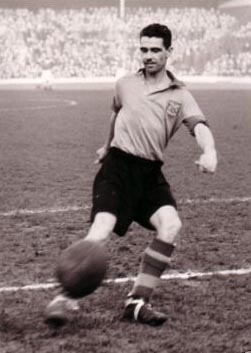
Nightingale: Albert
1952-1956
(Player Details)
Inside Forward
Born: Thrybergh, Nr Rotherham: 10-11-1923
Debut: v Sheffield United (a): 11-10-1952
5’8” 10st 3lb (1954)
Nightingale was one of fourteen children and his brother Ken also played football with
Rotherham United in the mid 1940's, while his elder brother Samson twice played for Lincoln
City in 1937 and later Scunthorpe United and Doncaster Rovers and also guested in War-time
games. Nightingale starred in local football in the Rotherham area with Thurcroft before he
joined Sheffield United when still not eighteen in June 1941, having already made his debut
for them in the Wartime 1940-41 season. It has been said that he also played for Doncaster
Rovers, Grimsby Town and Rotherham United as a guest during the War years, possibly under
an assumed name. However, it was his brother Samson that scored twice in seven appearances
in 1943-44 and six times in twenty-one League appearances and twice in the F.A. Cup in
1945-46, for Grimsby. It was also Samson that played for Doncaster Rovers, scoring six
times in twenty-three games in 1940-41, seven times in twenty-five games in 1941-42, and
had four games without scoring in 1942-43. Ken, who was two years younger than Albert,
scored twice in seven games in 1943-44 and six times in twenty-one games in 1945-46 for
Rotherham United. The young Albert Nightingale did, however play many games in the
war-time League, guesting with Chesterfield once in 1942-43 and again in 1944-45, but
scored in neither. It was a different story with his club Sheffield United, where, after
his one game in 1940-41 went on to become a leading player and goalscorer. He scored twice
in thirteen games in 1941-42, fourteen times in twenty-eight games in 1942-43, and
seventeen times in thirty-five games in 1943-44, before topping the goalscoring in each of
the two final war-time seasons, with sixteen in thirty-four games in 1944-45 and
twenty-two in forty-one games in 1945-46, when the Blades won the Football League North
Championship. However, like so many other footballer, Nightingale had lost some of the
best years of his football career to the Second World War by the time he made his Football
League debut when he was almost twenty-three. But, although United came sixth in the first
season after the War, just eight points behind Champions Liverpool, and he had continued
his impressive form in the company of several fine players such as Jimmy Hagan, Harold
Brook, Colin Collindridge, Jack Smith, Albert Cox, Alex Forbes, Fred Furniss, Harry
Hitchin, Harry Latham, Jack Pickering, Walter Rickett and Dennis Thompson, he wanted to
move and after scoring fourteen goals in sixty-two League games in peace-time League
football, he put in a transfer request. Leeds were in the running to sign him but he
joined Huddersfield Town in March 1948, in an exchange deal in which two home-produced
players, Graham Bailey and George Hutchinson, moved to Bramall Lane. Nightingale became a
legend in his short but successful Huddersfield Town career. Fans loved to see him in
action at the old Leeds Road ground. A hard-working inside forward, Nightingale spent three
and a half years with Town as they fought desperately to retain their First Division status.
He became popular for earning penalty kicks and re-enacted one of his dives when introduced
to the crowd before Town's final match at Leeds Road in 1994. In one hundred and nineteen
League appearances for Town he scored twenty goals and there was another goal in eight
games in the F.A. Cup. He was certainly not as prolific with Town as he had been at Bramall
Lane, with one goal in eleven games in the 1947-48 season, four in twenty-eight in 1948-49,
seven in thirty-nine in 1949-50, six in thirty-four in 1950-51 and two in seven games in
the 1951-52 season before he left for Ewood Park. When he left Huddersfield in October 1951,
Leeds were again in the race to sign him, but this time losing out to Blackburn Rovers, who
succeeded with a £12,000 bid. He made his debut only two hours after signing for Rovers. He
made thirty-five League appearances in their Second Division side and scored five goals. In
October 1952 he was on his travels again, this time to Elland Road after the Peacocks made
a £10,000 offer. In the Leeds United programme for the first home game played by the new
acquisition, on 18th October 1952 against Barnsley There was a nice welcome for the popular
Yorkshireman. "We are pleased to extend a hand of welcome to Albert Nightingale, who joined
us last week and who signalised his debut with us by scoring our only goal at Bramall Lane last Saturday. Albert was born at Rotherham and joined Sheffield United in 1942 as a boy.
He reached Elland Road via Huddersfield Town and Blackburn Rovers, and it was he who helped
very considerably to raise the Rovers from what seemed an impossible position to security
and even to the semi-final of the Cup. We hope his presence will be equally helpful in
staging our own comeback." There was a League table in that programme showing United's
plight as of 11th October 1952. They were nineteenth of Twenty-two in the Second Division,
with nine points from thirteen games, three above bottom club Barnsley, who had two games
in hand. Their prayers were answered! Albert Nightingale was among the best inside-forwards
of his day. His stamina sapping runs into opposition territory and his sense of fun on the
field made him a big favourite with Elland Roaders. He marked his League debut for Leeds
with a goal and became an excellent inside forward, particularly alongside John Charles.
Always a regular, when not injured, Nightingale was more prolific as a goalscorer than at
any other time in his career but still created chances for others and he could usually be
found high on the list of United’s goalscorers each season but always behind the freakishly
prolific John Charles, whenever he played up-front. United were always among the favourites
for promotion each season but three years flew by without them achieving their full potential
as the 1954-55 saw them in fourth position. For a time it looked as though they had missed
the boat in 1955-56 also, as they went into Easter looking well out of the running after a
spell of three defeats and a draw in four consecutive games. But United came home with an
unbelievable run of two victories and a defeat at Nottingham Forest, when again all seemed
lost, and then six wins on the trot to gain promotion with a 4-1 victory at Boothferry Park.
Nightingale scored twice in the Easter Monday 6-1 home win over Fulham and both goals in a
2-0 win in the vital penultimate game of the season at his local team, Rotherham. With ten
goals in twenty-six games, he had done as much as anyone to ensure United had gained promotion
to the First Division. But fate was to strike United and Nightingale a cruel blow. United
absolutely blew away Everton in their first game in the top flight in 1956-57, scoring the
first goal of the season in the entire League and going 5-0 up by half-time. Sadly,
Nightingale’s career was brought to an abrupt end when he received a bad knee injury in the
second half and United finished with ten men but still won 5-1. It proved to be his final
game and after retiring from football at the age of thirty-two and in a brilliant run of form,
he could only relect on what might have been. A storeman in an electrical company, he became
a green keeper at Woodsome Hall Golf Club until retirement, he lived in Almondbury, West
Yorkshire until his death. Bob Paisley, the former Liverpool Manager and stalwart player,
described him as "the toughest opponent I ever came across". He played with the fire,
commitment and wily gamesmanship that Buckley's Leeds side could often be accused of lacking.
There were accolades from his teammates. His former Leeds captain, Tommy Burden said "You
were pleased to have him on your side - he was a bugger when he was tackling." Another, the
great John Charles said "He'd get tackled on the halfway line and fall down in the area.
"While a young Jack Charlton added "Albert was notorious in the six yard area. As the ball
was being played into the box, he would tap his opponent on the ankle, the fellow would howl
and grab his foot - and our Albert would be free to knock the ball into the net. Nine times
out of ten, the referee didn't spot it because he was following the ball, but the other
players knew exactly what had happened, and I saw them chasing him around the pitch or
complaining to the ref." Harold Williams said: "He was a big pal and a real character.
But he was a sly one...He'd tap defenders' ankles and when they retaliated he'd go down."
After retirement he lived in Huddersfield. He had fond memories of Thrybergh, and remembered
handing out awards in a local Pub, possibly, The Fullerton Hotel. Nightingale, although he
was a pensioner donated £100 to help out one of his old clubs, Huddersfield Town. He had
been shocked to hear the club was having difficulties. His donation was to prompt other
ex-stars to donate, and in a report by Mel Booth, of The Huddersfield Daily Examiner this
is what was said. "It has all taken off since the magnificent gesture by Albert Nightingale,
with some players acting on their own initiative to send donations following all the
publicity in the Examiner". The man famous for winning free-kicks near the halfway line
and landing in the penalty area died at the age of eighty-two. He was taken ill at his
daughter's home in Liverpool and passed away on Sunday 26th February 2006.
| Appearances | Goals |
| League 130 | 48 |
| F.A. Cup 5 | 0 |
| |
| |
Obituaries and Comments by others
Albert's nephew, Lawrence ‘Lol’ Morgan, was a full-back with Huddersfield Town, Rotherham
United and Darlington from 1949 to 1964. He and others had this to say about his uncle in the
Northern Echo, first published Tuesday 12th April 2005. “In with both feet as usual, our last
column recorded Big Jack Charlton's thoughts on the dirtiest player he ever knew. The usual
black book suspects were lined up and eliminated: not terrible Tommy Smith, pernicious Peter
Storey nor even Ron Harris, indelibly, ineffably ‘Chopper’. The muckiest of all, said Jack,
was Albert Nightingale, at Leeds in the 1950s when he himself was a bit bairn from the back
of the shaft. A chap on a Leeds United website also reckons that Albert invented diving. "He
could be tripped on the halfway line and hit the penalty area; a great player, though."While
he may not be singing quite so lustily, Albert Nightingale was still very much alive, still
smoking like a Huddersfield mill chimney. His nephew, by happy chance, is former Darlington
player-manager Lol Morgan. "Oh he was dirty, quite bad, and also won more penalties than
anyone I've ever known," concedes Lol, now seventy-three. "Albert was absolutely renowned
for it, but off the field he was very gentle, as soft as a brush." Nightingale - slicked
black hair, black moustache, looks of a fifties film star - was born in Thrybergh, South
Yorkshire, described on the village website as "a true sporting legend." Uncle and nephew
were together at Sheffield United, where Albert is also remembered by Malcolm Bailey in
Norton-on-Tees, himself a Blades apprentice from 1949-51. "Replaced the late, great Jimmy
Hagan," Malcolm recalls. When Albert moved to Huddersfield, he recommended they sign the
lad, too. After a spell with Blackburn Rovers, Albert ended up at Leeds, where he hit
forty-eight goals in one hundred and thirty-five appearances between 1952 and 1957 and is
said to have combined well with John Charles. Lol Morgan, who later tried to sign the
thirty-nine-year-old Charles for Darlington, had reached Rotherham, training in the morning,
flogging advertising for the Rotherham Advertiser in the afternoon and remembered for his
ability to run as fast backwards as forwards. "We played against each other once or twice
but I don't think we clashed," says Lol. "He wouldn't have hurt one of the family." Thanks
also for memories to Paul Atkin in Northallerton and John Briggs in Darlington, and to all
those who spotted a typing mistake in the report of Big Jack's appearance at Willington.
He'll be seventy, not sixty, on May 8. Lol himself had a fifteen-year Football League
careerin which he made three hundred full back appearances and never once scored a goal.
"I remember one of my grandchildren giving the fact a few moments consideration, then all
bright eyed asking if I'd ever taken a corner," he recalls. He succeeded Eddie Carr at
Feethams in 1964, initially billeted on Charles Brand, club secretary and former town clerk,
who in his seventies still rode to the ground on his bike. "Throughout my career there he
never once called me Lol, or even Lawrence, just Morgan. He was a nice enough chap, just old
- fashioned." In 1966 he steered the Quakers to a first promotion in forty years, having
inherited crowds of 3,000 and doubled them, despite admission rising to four shillings. "I'm
no financial expert," he says, "but I remember reading somewhere even then that Manchester
United made more from selling programmes than we did on gate receipts." The league's lowest
paid manager, he was offered an extra tenner a week for winning promotion, left for Norwich
City, returned to his native Rotherham after being sacked - "He's absolutely in love with
the place," says Pauline, his wife - and hasn't worked in football since. "I've only been
to watch Rotherham two or three times this season," he admits. "I think all this borrowing
players has stopped the chances of youngsters developing." Instead he's junior golf
organiser for the Sheffield Union, back on the course himself, despite a knee replacement
last September. The other knee awaits expectantly. Uncle Albert, now 81, lives in
Huddersfield, still gets in a game of bowls ("You can't dive in bowls") still sports a
moustache and combed back hair. "He never looked tough," says Lol. "Tommy Smith and Ron
Harris looked as hard as they were but Albert was just five foot eight inches and quite
slightly built."Eventually he got a nasty knee injury, cruciate ligament, you know - and
they wanted to experiment with a plastic ligament. It was a serious operation in those days
and he wouldn't let them do it, he retired at thirty-two. "He's not as well as he was and
doesn't shave as often as he should. If he did, people would still recognise Albert
Nightingale. They'd probably run a mile."
THE PASSING OF A LEGEND
Alan Hodgson of Huddersfield Town F. C. informed the public that Albert had passed away.
This tribute was made by him to Albert. "I'm afraid I have a bit of sad news for now as
Albert Nightingale recently passed away. We put a tributary piece in the last home match
programme that reads as follows: Albert Nightingale, veritable Town legend, died last Sunday
(February 26th) at the age of 82. Nightingale scored 87 goals in 346 career appearances and
endeared himself to the Leeds Road fans. A hard-working inside forward, Nightingale spent
three and a half years with Town as they fought desperately to regain their First Division
status. He became popular for earning penalty kicks and re-enacted one of his dives when
introduced to the crowd before Town's final match at Leeds Road in 1994. A true legend!
Alan Hodgson 2006
Obituary: Albert Nightingale
28th February, 2006 By Huddersfield Examiner
Albert Nightingale became a legend in his short but successful Huddersfield Town career.
Fans loved to see him in action at the old Leeds Road ground. But the man famous for winning
free-kicks near the halfway line and landing in the penalty area died at the age of 82. He
was taken ill at his daughter's home in Liverpool and passed away on Sunday. Nightingale
scored 87 goals in 346 career League appearances and endeared himself to the Leeds Road fans
in his three years with Town. He began his official career with Sheffield United in the early
part of World War II but had actually played for Rotherham United at the age of 17 - under
another name! He was almost 23 when he made his debut in peacetime football. The youngest of
14 children, he quickly established himself and, when Town signed him in March, 1948, it was
an exchange deal in which two home-produced players, Graham Bailey and George Hutchinson,
moved to Bramall Lane. A hard-working inside forward, Nightingale spent three and a half
years with Town as they fought desperately to retain their First Division status. He became
popular for earning penalty kicks and re-enacted one of his dives when introduced to the
crowd before Town's final match at Leeds Road in 1994. Nightingale commanded a £12,000 fee
when he moved to Blackburn Rovers in September 1951 and made 27 appearances in their Second
Division side. Twelve months later, at the third time of trying, Leeds United signed
Nightingale for £10,000. It proved to be his most successful period and he made 135 senior
appearances for United before injury forced his retirement at the relatively young age of 32.
Bob Paisley, the former Liverpool manager, described him as "the toughest opponent I ever
came across". A keen golfer, Nightingale won the PFA championship in 1956 and worked at
Woodsome Hall Golf Club. He was also a keen bowler and had been living in Almondbury, bowling
for the Liberal Club sides. He was a widower and leaves a daughter Tess and two grandchildren,
Jane and Mark. The funeral service is on Tuesday, March 7 at 2pm at St Joseph's RC Church.
Albert Nightingale
Yorkshire Post 4th March 2006
Leeds United forward Albert Nightingale, who has died aged 82, was an inside forward with
a dashing style and looks and was a popular figure in the Leeds United team in the John Charles
era. He made 132 appearances for Leeds in four years from 1952 until injury forced his
retirement at the age of 32. It took three attempts by United to sign Rotherham-born Nightingale,
who began his career at Sheffield United during the war, although he had played for Rotherham
aged 17 under another name. He chose to move to Huddersfield Town in March 1948 as part of an
exchange deal, making 119 First Division appearances for them in three-and-a-half years before
moving to Blackburn Rovers for 12,000 in September, 1951. But 12 months later United got him for
10,000. A fans' favourite, he had a knack of winning penalties, at times from incidents that
occurred well outside the area. Legendary Liverpool manager Bob Paisley often played against
Nightingale, who scored 87 league goals in his 346 career league appearances, and said of him:
"He was the toughest opponent I ever came across." Former Leeds teammate Harold Williams, 81,
said: "He was a big pal and a real character. But he was a sly one...He'd tap defenders' ankles
and when they retaliated he'd go down." A widower, he lived in Almondbury, Huddersfield. His
funeral will be at St Joseph's RC Church, Huddersfield, on Tuesday at 2pm.
|