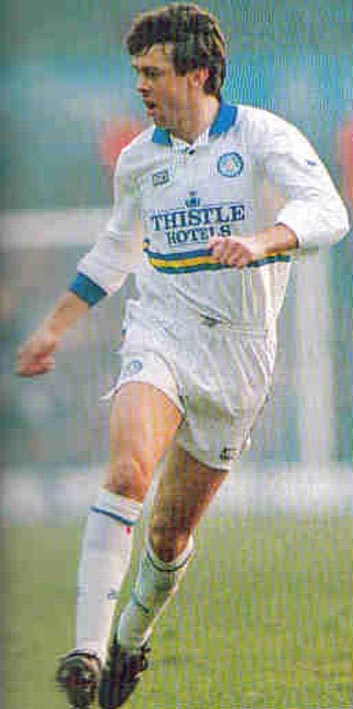
O’Leary: David Anthony (David)
1993-1995
(Player Details)
Central Defender
Born: Stoke Newington, London: 02-05-1958
Debut: v Manchester City (a): 14-08-1993
6’2” 12st 6lb (1993)
Although O’Leary was born in London he moved to live in Dublin at the age of three. His
father was born in Ireland and O'Leary later decided to play for the Republic of Ireland. He
went to school in Dublin at St Kevin’s, Glasnevin and captained the Irish Schools side. He
played for Shelbourne Juniors and had unsuccessful trials with Manchester United before
joining Arsenal as an apprentice in June 1973. He soon progressed through the ranks at
Highbury, playing in the reserves at the age of sixteen. He made his debut for Arsenal in a
0-0 draw at Turf Moor against Burnley on 16th August 1975, and despite being only seventeen,
went on to make thirty appearances that season, of which twenty-seven were in the league.
For the next ten years he was almost ever-present in the Arsenal side, playing more than
forty matches a season, except for 1980-81, when he was injured and only played twenty-seven.
His League appearances in those successive seasons were twenty-seven in 1975-76, thirty-three
in 1976-77, forty-one in 1977-78, thirty-seven in 1978-79, thirty-four in 1979-80, twenty-four
in 1980-81, forty in 1981-82, thirty-six in each of 1982-83, 1983-84 and 1984-85, thirty-five
in 1985-86 and thirty-nine in 1986-87. A fine record of just eighty-six games missed in twelve
seasons in the League. During that fine spell he was elected into the annual PFA Team of the
Year for the First Division, three times in four seasons from 1978-79 to 1981-82, the
exception being 1980-81, when he had the injury problems. He was made Arsenal's captain in
1982 but was replaced by Graham Rix eighteen months later. The arrival of George Graham in
1986 bought renewed vigour from O'Leary and he steadily regained his status as one of the
League’s most reliable defenders. But the Littlewoods Cup triumph of 1987 proved to be the
last season in which O’Leary would command a regular berth. An ankle injury sidelined him for
much of the following campaign and his involvement in the title-winning surge in 1989 was
sporadic. However, in 1989 he became Arsenal’s record appearance holder, surpassing George
Armstrong’s record of six hundred and twenty-one first team games. He was no longer first
choice under George Graham at this time, with Steve Bould and Tony Adams starting most games.
Despite this, O’Leary played twenty times as Arsenal won the league. It came with him largely
at right-back but nevertheless he completed his duties with aplomb. It earned him further
respect and three years later O’Leary was spending more time in the side than out of it.
Fittingly for such a loyal servant, his swansong, in his twentieth season of association with
the Club, was the 1993 FA Cup Final. Coming on as a substitute for Ian Wright, nine minutes
from the end of ordinary time in the replayed Cup final which Arsenal won 2-1 after extra-time
against Sheffield Wednesday on 20th May 1993, gave him one final piece of silverware together
with them completing the Cup double, as they also won the League Cup. It was a special end to
a very special playing career with Arsenal. Although his final six seasons had seen him start
to miss more games as injuries took their toll but he still remained one of the best defenders
in Europe, deceptively quick, supreme in the air and a wonderful distributor of the ball.
While at Highbury, he had scored eleven goals in five hundred and fifty-eight League games of
which thirty-five were as a substitute, in the League Cup he had scored twice in seventy games,
of which two were from the bench, in the F.A. Cup he netted once in seventy games, of which
one was as a substitute, he played twenty-one games in European competitions and three games in
Charity Shields making a total of fourteen goals in six hundred and eighty-one starts and forty
one games from the bench, an Arsenal record of seven hundred and twenty-two appearances. He was
nicknamed "Spider" by Arsenal fans because of the way his long legs were always intercepting
passes from the opposition. An Irish Youth International, he was at the heart of many of
Arsenal’s victorious teams, winning League Championship medals in 1988-89 and 1990-91, FA Cup
winners’ medals in 1979 and 1993 and League Cup winners’ medals in 1987 and 1993. He also won
runners-up medals in the F.A. Cup in 1978 and 1980 and the European Cup Winners' Cup in 1980.
He made his Republic of Ireland debut against England in a 1-1 draw at Wembley in September
1976 as an eighteen-year-old and clearly made an impression on Irish Manager John Giles as
O’Leary was a regular in all Giles' teams. His successor Eoin Hand also kept O’Leary in the
side alongside centre half partner Mark Lawrenson. He made forty-six appearances between 1976
and 1986. In 1986 Jack Charlton took over as Manager of the Irish team and O'Leary's time as an
automatic choice came to an end. He was left out of a squad for an end of season tournament in
Iceland in May 1986 by Charlton. The squad was hit with several withdrawals and O’Leary was
called up. He had booked a family holiday and refused to cancel it and declined to join up with
the squad. This cost him dearly as he was left out of the Irish squad for two years, culminating
with him not travelling to the European Championships in 1988, Ireland’s first major
international tournament. O’Leary did go to the 1990 World Cup in Italy having reconciled with
Charlton but was down the pecking order, with Kevin Moran and Mick McCarthy being first choice.
He claimed a place in Irish sporting folklore when he scored the winning penalty against Romania
in a second round penalty shoot out, which took the Republic into the quarter-finals for the
first time in their history. He continued to represent his country until 1993, being involved in
the 1994 World Cup Qualifying campaign. He was made captain for his sixty-eighth and final
appearance on 17th February 1993 in a 2-1 win over Wales in Dublin. He remained with Arsenal
until he was given a free-transfer and joined Leeds in July 1993 aged thirty-five. Looking for
experience to assist young central defenders David Wetherall and Jon Newsome, Leeds boss Howard
Wilkinson opted for the Arsenal Legend on a three year contract. The holder of sixty-eight
Republic of Ireland caps, he had spent twenty years at Highbury amassing a club record of
appearances. His class was obvious on his Leeds debut, but it was not long before his ageing
limbs ran into injury problems and he was forced to give up the game in 1995 with Achilles
tendon trouble. When Jack Charlton stood down as Ireland’s Manager, O’Leary was amongst those
suggested as a possible successor before the appointment of Mick McCarthy. O’Leary’s younger
brother, Pierce, played for Shamrock Rovers, Celtic, Vancouver Whitecaps and Philadelphia Fury,
winning seven full Irish caps. He skippered Celtic when they met Arsenal at Highbury in August
1986 in his brother’s testimonial game. When the former Arsenal manager George Graham was put
in charge at Leeds, in September 1996, O'Leary was installed as his assistant. He remained in
this position for two years until Graham moved to Tottenham Hotspur. After Graham left for
Tottenham, the Leeds board offered Martin O’Neill the manager's position, but the deal fell
through and O'Leary was instead promoted to the hot seat. At the end of 1998-99 Leeds finished
fourth in the EPL and qualified for the UEFA Cup. Their 1999-2000 campaign ended in the
semi-final with defeat to the Turkish side Galatasaray. On the domestic front, Leeds finished
third in the Premiership and qualified for the Champions League. It was their first campaign
at that level since the 1992-1993 season. Leeds reached the Semi-Finals of the Champions
League in 2000-2001, where they lost to eventual runners-up Valencia. Their Premiership form
also dipped slightly and David O'Leary's men had to settle for a UEFA Cup place. Although
there was little indication of this at the time, this was a serious failure for the club
because Chairman Peter Ridsdale had borrowed £60 million against future gate receipts,
budgeting for prolonged Champions League involvement. 2001-02 began well for Leeds. They
frequently topped the table during the first half of the season and were Premiership leaders
on 1st January 2002. However, loss of form in the second half of the season saw them slump
into sixth place, the last automatic UEFA Cup place. The season was thrown into turmoil by
the involvement of four players, including first-teamers Jonathan Woodgate and Lee Bowyer,
in an incident in Leeds City centre that ended in the assault and injury of an Asian student.
O'Leary to some extent alienated the fans, and more importantly Ridsdale, by writing a book,
“Leeds United On Trial”, that some saw as cashing in on the troubles the club had suffered.
By June 2002, O'Leary had spent almost £100 million on new players in less than four years
for no reward in terms of trophies, but O'Leary had never finished outside the top six as a
Manager. Ridsdale sacked O'Leary as Leeds Manager in the summer of 2002, replacing him with
Terry Venables. O'Leary's departure signalled a downhill spiral for the club which would see
three more managers (Venables, Peter Reid and Eddie Gray) come and go before the club was
finally relegated from the Premiership in 2004 with £80 million debt. Even so his dismissal
came as a surprise and was the first indication of the growing crisis at Leeds United.
O'Leary, meanwhile, was linked with various other vacant Managers' jobs throughout the
2002-03 season. He was hot favourite to become manager of Sunderland when Peter Reid was
sacked in October and again when Howard Wilkinson was sacked in March. But O'Leary remained
out of work until June 2003 when he was appointed manager of Aston Villa. They had finished
sixteenth in the Premiership and manager Graham Taylor’s second spell as manager had come
to an end after just over a year. So Villa chairman Doug Ellis turned to David O'Leary in a
bid to see the club's fortunes turn around. By the beginning of November 2003, Aston Villa
were hovering just above the relegation zone and it looked as though O'Leary would be
another of the club's unsuccessful managers. O'Leary remained at Villa and managed to get
an already good squad to perform successfully so that by the final weeks of the season they
were pushing hard for at least a UEFA Cup place and possibly even a Champions League place.
But in the end their early season form had caught up with them and they had to settle for
sixth place, one place too low for European qualification. During the 2004-05 season, Aston
Villa hovered just below the European qualification places, ending the season in tenth spot.
Despite a bright start to the season, they lacked the consistency that was attributed to
his first season in charge. O'Leary occasionally made complaints towards aspects of his
position which earned him the nickname "Dreary O'Leary" to some fans. Despite six summer
acquisitions including internationals Milan Baros and Kevin Phillips who added more
quality to the squad, the 2005-06 season brought a disappointing turn for the worse for
O'Leary. Injuries and suspensions decimated the squad, with only one fit centre back
(Liam Ridgewell) available for selection at one point. He became increasingly under-fire
from fans and media alike for a lack of tactical awareness, man management skills and
enthusiasm for the success of the club. A series of poor results saw Villa hovering
dangerously above the relegation zone going into December, with just seventeen points
from seventeen games. However an improved winter period saw them move slightly up the
league.This brief period of positive results was short-lived, and in the end, Villa
finished sixteenth, just two places above the relegation zone. A storm broke surrounding
David O'Leary and Aston Villa on 14th July 2006 when a press release, purporting to be
from the Aston Villa players, criticised the Chairman Doug Ellis. The statement was
rumoured to have been orchestrated by O'Leary to put pressure on Ellis to release more
transfer funds. The media storm finally came to a head when on 19th July 2006, O'Leary's
contract as Villa Manager was terminated by mutual consent. Despite many managerial
positions becoming available, O'Leary did not return to football management until 4th July
2010 when he took on the role with Al-Ahli of Dubai in the United Arab Emirates and had his
former Leeds Assistant, Roy Aitken once more with him, on a three year contract. It did not
last long, as he was relived of his duties after a heavy defeat by Al Jazira on 2nd April
2010 and only winning six of fifteen games, after initially starting well. He and his
assistant were both sacked twenty days later. He had to go to FIFA but ultimately, in May
2013, he was compensated for his over two years remaining on his contract and received
£3.34million. In the interim he was unemployed and subsequently he did not return to
coaching or managing but was an occasional TV pundit for Al Jazeera and BT Sport's.