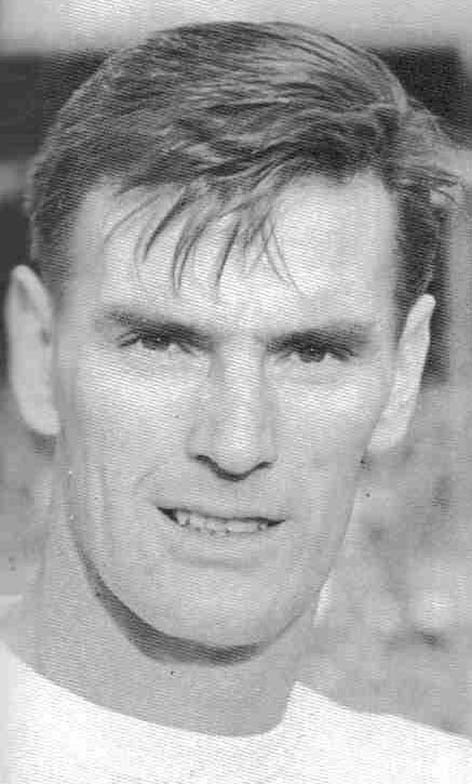
Peacock: Alan
1964-1967
(Player Details)
Centre Forward
Born: Middlesbrough: 29-10-1937
Debut: v Norwich City (a): 08-02-1964
6’1” 11 st 9lb (1963)
#72 in 100 Greatest LUFC Players Ever
A product of Lawson Secondary School, he joined Middlesbrough as a youngster, won England
Youth honours and turned professional in November 1954, however it took him over four years
to establish himself in the starting line up. He formed a prolific spearhead with Brian
Clough, scoring one hundred and twenty-six goals in two hundred and eighteen League
appearances and another sixteen goals in twenty Cup fixtures. Clough was to score two
hundred and four goals in two hundred and twenty-two games, while at Ayresome Park. Both
were to play for England while still with Second Division Boro, an unprecedented badge of
honour for the club and, but for a ‘notoriously’ leaky defence, their firepower would have
won promotion. Peacock came to prominence midway through the 1957-58 season when he
established himself as an ideal strike partner for Boro goal machine Brian Clough. Peacock's
unselfish attitude led to Clough claiming the majority of goals but not in one memorable
game on 8th November 1958 when both front men scored hat-tricks in a 6-1 win over Scunthorpe.
Peacock was eased into the Boro team with two goals in six games in 1955-56 and one goal in
four games in the following season as Clough topped the scorers with thirty-eight League
goals. After sporadic early appearances, Peacock dislodged Arthur Fitzsimmons and the
Clough/Peacock record over the next few seasons was nothing short of phonominal. In 1957-58
Clough bagged thirty eight in the league while Peacock got fifteen in twenty-two games.
Middlesbrough scored eighty-three goals that season. In 1958-59 Clough netted forty-three
and Peacock nineteen in thirty-four games as Boro totalled eighty-seven in the League.
1959-60 saw thirty-nine goals from the boot of Clough, while Peacock contributed thirteen
goals in thirty-five games in Boro’s total of ninety for the season. The final year of the
Clough/Peacock partnership, 1960-61, saw thirty-four from Clough and fifteen in thirty-four
games from Peacock as Boro totalled ninety in the League. Peacock was acknowledged as one of
the best headers of a ball in English Football in the post-war era. He was outstanding for
the club during the 1961-62 campaign, as he scored a prolific twenty-four goals in only
thirty-four League matches, following Clough's transfer to Sunderland. He also notched a
further eight in Cup matches. His exceptional form earned him a call up to play for England
in the 1962 World Cup finals. He was never on a losing side for England. He made his debut
on 2nd June 1962 at Rancagua in the 3-1 victory over Argentina, a game in which he had a
header pushed over the bar by the Argentine captain Navarro and Ron Flowers scored from the
resulting penalty, and five days later he was again in the line-up as England drew 0-0 with
Bulgaria at the same venue. As throughout his career, either injury or bad luck struck and
he went down with a stomach bug and he consequently missed the quarter-final defeat as
Gerry Hitchens took his place and scored in a 3-1 defeat by Brazil. He was back for the
home internationals, against Northern Ireland at Windsor Park, Belfast, when England won
3-1 and he then opened his international goal scoring account with two against Wales in a
4-0 victory at Wembley. His good form continued in 1962-63 when he topped the Boro scoring
with thirty-one goals in forty League games as well as two more in the Cup. Peacock grew
frustrated with Boro’s repeated failure to win promotion and so took a short cut into the
top flight when he moved to Leeds. Injury had sidelined him for part of the 1963-64 season
but he had still managed five goals in nine games when Leeds paid out £50,000 for him in
February 1964, but as part of the signing agreement there was a further £5,000 paid on
United attaining promotion. His eight goals in fourteen games lifted Leeds to Division One
in 1964, earning him a Second Division Championship medal. He was a member of the 1965 FA
Cup Final team and added two more England appearances while at Leeds to take his total of
caps to six, a number that could have been substantially increased, but for a succession of
injuries. He was in the team for the 0-0 draw with Wales at Ninian Park, Cardiff, on 2nd
October 1965 and then scored his third England goal in England’s 2-1 victory over Northern
Ireland at Wembley a month later, on 10th November. He seemed certain for a spot in Alf
Ramsey's 1966 World Cup squad. His form with Leeds in the 1965-66 season only confirmed
this, as he scored in three of the four opening Leeds' fixtures. He did not find the net
in the opening fixtures with Sunderland but netted in a 2-0 win at Villa Park against
Aston Villa, added another in a 1-2 defeat at Upton Park and then bagged a brace in the
return fixture with Aston Villa at Elland Road. to make it four in the first four games.
He was on the mark twice more at Filbert Street in a 3-3 draw with Leicester City to make
it six in nine League games. He was on the mark in the first leg of the Inter Cities Fairs
Cup First Round in a 2-1 win over Torino at Elland Road on 29th September 1965, a goal
which effectively took them through to the next round. But in the League he scored in a
6-1 home win over Northampton Town, followed by the opening goal in a 2-1 win over Stoke
City at Elland Road to take his tally to eight in thirteen games in the League. He had
been ever-present to this point and his form was such that his place in the England team
seemed assured. He picked up his first injury of the season in Leeds' 16th game of the
season in a 2-0 win over Arsenal at Elland Road on 13th November 1965 and after being
replaced by Terry Cooper in the match, he missed the following game against Everton at
Goodison Park on 20th November, their 2-1 win in Leipzig on 24th November and the home
leg 0-0 draw on 1st December in the Fairs Cup Second Round and also England's match in
Spain on 8th December but he returned for United's home fixture in a 4-0 win over West
Bromwich Albion on 11th December and then continue an unbroken string of games until
29th January 1966 when he was again injured at Sunderland and replaced by Rod Johnson.
This proved to be a season ending injury which saw Leeds lose the focal point of their
attack and the unique aerial dominance he brought to the team. In the latter spell he
had added two more goals, on 1st January at home to Sheffield Wednesday, and, a week
later, the other at West Bromwich Albion to take him to double figures, with ten goals
in twenty-four League games. It was a hard blow for Leeds and coupled with the loss of
midfield general Bobby Collins for most of the season, he managed but ten League games,
it was little wonder that they finished runners-up, six points behind Champions Liverpool.
The final outcome was far away from the championship medal and World Cup winners' medal
which had seemed imminent at the halfway point of the season. Over the next year he had
three knee operations and had to be satisfied with two goals from his six appearances in
the League. He went to Plymouth Argyle in October 1967 for £10,000 but was forced to
retire in March 1968 at the early age of thirty, after scoring only once in eleven games.
He returned to his native City after retirement and later ran a newsagents business in
Middlesbrough and became a matchday host at the Riverside. He also founded the
Middlesbrough Former Players Association in 2005. "In November 2005, Peacock became
president of non-League Guisborough Town and in December 2006 he was awarded a Lifetime's
Achievement Award by the Evening Gazette in Middlesbrough for his services to the club,
a fitting tribute to one of the nicest but unluckiest men in football." Courtesy David
Tomlinson.