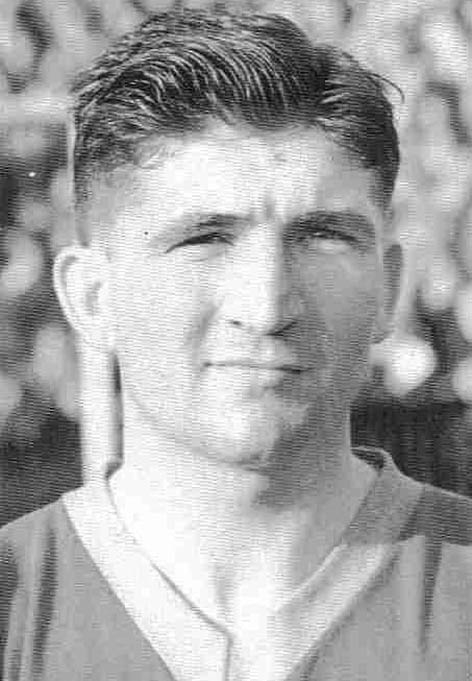
Peyton: Noel
1958-1963
(Leeds Player Details)
Inside Forward
Born: Dublin, Republic of Ireland: 04-12-1935
Debut: v Bolton Wanderers (a): 01-02-1958
5’5” 10 st 0lb (1958)
Peyton was with Shamrock Rovers for five seasons before joining Leeds for £5,000 in
January 1958. With Rovers he won plenty of domestic honours. In 1953-54 he won the first of
his League of Ireland Championships and in 1954-55 he won his first League of Ireland Shield
and his first FAI Cup Cup-winners medal. In 1955-56 he won his second League of Ireland
Shield and FAI Cup Cup-winners medal and his first Leinster Cup. 1956-57 saw him gain his
second League of Ireland Championship, third League of Ireland Shield, second Leinster Senior
Cup and first Dublin City Cup. On a personal level he made his full Republic of Ireland debut
against World Cup holders, West Germany, in front of 35,000 at Dalymount Park in Dublin 25th
November 1956, when the Irish recorded a famous victory by 3-0. After a quiet start he came
into the picture much more in the second half as he gathered confidence and finished the game
strongly as one of the stars of the game. He also played twice in European competition for
Rovers. On 20th October 1957 he had also gained a Republic of Ireland "B" International Cap in
front of a huge 52,000 crowd at Dalymount Park in a 1-1 draw with Romania "B". The game was
remarkable for the inclusion of three East Wall reared players in the Irish team, Liam Tuohy,
Dick Whitaker and Noel Peyton. All three had lived a stone's throw away from each other in
East Wall. Tuohy on Shelmelier Road, Whittaker on Marys Road and Peyton on Russell Avenue. In
addition to his caps Peyton had also represented the League of Ireland at an Inter-League level
on five occasions. He had made his debut in the 1956-57 season when he represented the League
of Ireland in a 3-3 draw with the Football League in front of 40,000 people at Dalymount Park
on 19th September 1956 and this was quickly followed by a second just one week later in a 1-3
defeat by the Scottish League at Shawfield Stadium, Glasgow in front of 18,000. He also played
in the third Inter-League game of the season on 18th March 1957 in a 2-2 draw with the Irish
League in front of 29,890 at Dalymount Park and Peyton scored the first League of Ireland
goal. There were two more to follow in 1957-58 before he made the move to Leeds for £5,000 in
January 1958 and on 18th September 1957 he was in the team that were beaten 1-5 in front of
23,000 at Dalymount Park by the Scottish League and soon after, on 9th October, he played his
fifth Inter-League game in front of 13,000 at his future home ground of Elland Road, Leeds,
in a 1-3 defeat by the Football League. Eire International Peyton was in and out of the Leeds
team during his stay at Elland Road. He won five more caps at Leeds, but his time there was
not in a successful period as the club struggled to come to grips with the loss of John
Charles. He did continue to represent the Republic and his second cap, on 11th May 1960 saw
another famous Irish victory as they triumphed 1-0 over the West Germans at the Rheinstadion
in Dusseldorf before a crowd of 51,000. This success was followed by his only two failures in
the green shirt as he replaced the injured Noel Cantwell just before half time in a 4-1 defeat
by Sweden in Malmo, seven days later. When they were beaten 3-2 in front of 20,000 at
Dalymount Park by Wales, on 28th September 1960 Leeds had three present and future players on
duty for the Republic as Peter Fitzgerald, as well Peyton, and Johnny Giles, who was still
with Manchester United at the time, but all failed to impress. On signing he went straight
into the Leeds team in a 2-0 victory over Bolton Wanderers on the usual Burnden Park quagmire,
a game which also saw the debut and only first-team game of goalkeeper Willie Nimmo. Peyton
was more successful, establishing himself in the United team for the rest of that season, as
United slumped to seventeenth in the First Division. The arrival of Irish International
outside-right Billy Humphries saw Chris Crowe move into Peyton’s inside-right berth and
Peyton found himself with stiff opposition from George O’Brien and Bobby Forrest for the
remaining inside-forward berth. However all three were out of favour following the arrival
of Don Revie from Sunderland and he featured in only eight games in that 1958-59 season as
United struggled to fifteenth in the League. The 1959-60 season saw the departure of O’Brien
and Forrest and the arrival of Bobby Cameron and there were twenty appearances as United
suffered relegation. With Revie or Bremner in the inside right spot, Peyton filled the inside
left spot twenty-three times, becoming a regular after Revie concentrated on the managerial
aspect of his new position. 1961-62 again found Peyton in favour missing only five League
games as United dropped to an all-time low of nineteenth in the Second Division, narrowly
avoiding relegation. Revie had drafted in several experienced old campaigners as he was
confronted with the prospect of relegation, Bobby Collins being the most important of these.
Peyton found himself once more on the outer as Revie recruited key players such as Jim
Storrie and started to blood his youngsters as he put together a team capable of obtaining
promotion in 1962-63 but did not quite make it as United finished fifth and Peyton had to be
content with just six appearances at outside and inside-right. He was still picked for the
Republic for his final two games at international level. The first on 2nd September 1962,
against Iceland in Reykavik as they drew 1-1 before a crowd of 9,100 at Laugardalsvollur to
gain passage in a first round European Cup qualifier and then on 9th June 1963 he was part
of the team, along with Johnny Giles, that beat Scotland 1-0 in front of 26,000 at Dalymount
Park in Dublin in another shock result. It was his sixth and final full cap, but he was
replaced by Ambrose Fogarty just before half-time. It came as little surprise when a £4,000
transfer took him to York City in July 1963. He had two seasons there making thirty-seven
appearances and scoring twice. In May 1965 he became player-manager of Barnstaple Town. He
later worked part-time at William Hill in Bradford.