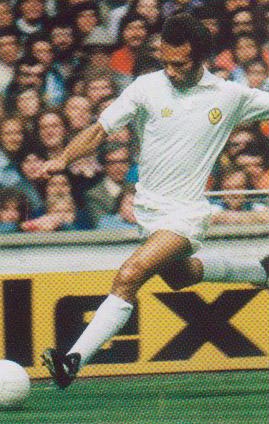
Reaney: Paul
1961-1978
(Player Details)
Right Back
Born: Fulham: 22-10-1944
Debut: Swansea Town (a): 08-09-1962
5’10” 11st 3lb (1971)
#15 in 100 Greatest LUFC Players Ever
Right Back in Greatest LUFC Team
He was only a few weeks old when his family left London for Leeds, where he attended
Cross Green School and played for Middleton Parkside Juniors. He was an apprentice motor
mechanic when he joined Leeds’s groundstaff in October 1961. Reaney’s League debut followed
less than a year later and he shared the ‘Glory Days’ under Don Revie. He impressed quickly
and made thirty-five League appearances in his first season, and was part of the team which
won the Second Division in 1964. Reaney settled into top-flight football, missing just one
League game and scoring his first of six League goals for the club as Leeds challenged for
both the Football League Championship and the FA Cup. Unfortunately, in what would become a
recurring scenario for Leeds under manager Don Revie, they lost out on both. Manchester
United winning the title on goal difference and Reaney also featured in the side beaten at
Wembley, after extra-time, in the FA Cup final by Liverpool. Over the next three seasons,
Reaney missed just a handful of appearances as Leeds made further progress. Their classic
back four was formed by 1967, with Reaney alongside Jack Charlton, Norman Hunter and Terry
Cooper with utility man Paul Madeley frequently stepping into any of their positions when
needed. Reaney had started to gain International recognition and had made his England
Under-Twenty-three debut at Roen in France in a 2-2 draw on 8th April 1964. The team then
went on tour but Reaney only went for the ride as Len Badger was preferred against Hungary
in a 1-2 defeat in Budapest on 13th May 1964, in a 0-3 defeat by Turkey in Istanbul on
20th May 1964 and against Israel in a 4-0 win at Tel Aviv on 27th May 1964. He played at
left back on 24th February 1965 in 0-0 draw at Pittodrie against Scotland, but missed the
0-0 draw with Czechoslovakia at Elland Road on 7th April 1965. He was included at right
back in Freiburg on 25th May 1965 when West Germany won 0-1 and four days later in Liberec
in a 0-0 draw with Czechoslovakia, but then missed the 0-0 draw with Austria in Vienna on
2nd June 1965. George Cohen and Jim Armfield were ahead of him into the 1966 World Cup team.
Keith Newton, Cyril Knowles and Tommy Wright were also given chances before Reaney. He was
not picked for the Under-Twenty-threes in 1965-66, Lawler being preferred, but he was picked
for the Football League in a 1-3 loss to Scotland at Newcastle on 16th March 1966. He was
picked for the England Under-Twenty-Threes on 1st March 1967 in a 1-3 defeat by Scotland at
Newcastle but that was his final England Under-Twenty-Three game. It was an injury to Terry
Cooper that got him his first cap. Keith Newton and Bob McNab were picked with Reaney a
substitute, with Reaney debuting as Newton's replacement with 10 minutes to go against
Bulgaria in a 1-1 draw at Wembley on 11th December 1968. Cooper returned as left back and
Newton held the right back spot. If Cooper was unavailable Newton would switch to left back
and Tommy Wright would get the nod at right back from Sir Alf Ramsey. Reaney was again
picked for the Football League in a 3-0 win over League of Ireland at Oakwell, Barnsley, on
10th September 1969. In 1968 Leeds had won the League and the Inter-Cities Fairs Cup. In
1968-69 they achieved their goal of the League championship. Reaney was an unsung but truly
vital part of what had now become a feared and admired team. However, it was a year and ten
matches after his first cap that Reaney got his first start, at Wembley against Portugal on
10th December 1969. Big Jack won the game with a 24th minute header with Reaney and Emlyn
Hughes the full back pair. Both gave good accounts of themselves and seemed to have earned
a place in the squad for the World Cup. In fact, Reaney had already been selected for that
squad when tragedy struck. Leeds had progressed in 1969-70 towards a unique "treble" of
League championship, FA Cup and European Cup but Reaney suffered twice the heartbreak. Not
ony did Leeds miss out on all three trophies, the League went to Everton on the last day;
the FA Cup was won by Chelsea after a replay; and Celtic ended Leeds' European Cup bid in
the Semi-Finals, but Reaney suffered a broken leg in a game against West Ham United on 2nd
April 1970, and missed the run-in, including the FA Cup final. Paul Madeley deputised for
him for the rest of the season and Reaney missed the summer's World Cup in Mexico. Leeds
started the following season without Reaney as he battled back from what was the first
serious injury of his career. He was out for over six months but he won his way back into
the Leeds team. He eventually returned to make eighteen League appearances and be part of
the team which won its second Inter-Cities Fairs Cup, but missed out on the League
championship on the last day again. He did however, win one more England cap, though no
more would follow. He made his third appearance for England in a European Qualifier in
Malta on 3rd February 1971 which England won 1-0. The following month he was in the
Football League team that beat the Scottish League 1-0 at Hampden Park on 17th March 1971,
for his third such representative game, and he was selected for England's next game with
Greece at Wembley on 21st April 1971, but had to withdraw due to injury. He never played
again for England as Sir Alf Ramsey gave chances to Chris Lawler, Peter Storey and Paul
Madeley and then Don Revie never picked him. Reaney was in the side which went yet again
for the "double" in 1971-72 and this time was partly successful. They finally won the FA
Cup in their third final, defeating holders Arsenal at Wembley, but then lost the League
title after a last-day loss to Wolverhampton Wanderers. In 1972-73 there was more
disappointment for Reaney as Leeds lost the FA Cup final to Sunderland and a highly
controversial European Cup Winners’ Cup Final to AC Milan, in which in the absence of
several main Leeds players he led the Leeds team as Captain. Reaney's career at Leeds
passed five hundred appearances in 1973-74 as Leeds embarked on a record twenty-nine-match
unbeaten start to the season to earn the League title for the second time under Revie, who
then left Leeds to take over the England job. Reaney was in the team which duly progressed
to the European Cup Final a year later, but yet again Leeds were defeated, and no more
honours would come their way as the great team assembled by Revie began to age and split
up. One consolation for Reaney was that in 1975-76 he was granted a testimonial by the
club. It culminated in a match against Newcastle United on 3rd May 1976, and he remained
with the club for two seasons beyond that. He also became known during his peak years as
the only player who could mark George Best out of a game, a fact acknowledged by Best
himself. He continued to play at Elland Road until 1978 when he was given a free transfer
after seven hundred and forty-five appearances. He was remembered fondly by Leeds fans for
his pinpoint crosses, goal-line clearances, overlapping runs and just for being there as
the player whose profile was possibly the lowest of all Revie's great players, yet who
ended up third in the club's all-time appearance list, with only Jack Charlton and Billy
Bremner having played more games for United than Reaney. Football remembers him as the
strong, silent, untroublesome one in a great and controversial team. He collected two
League Championship medals, an FA Cup Winners’ medal, League Cup Winners’ medal,
Inter-Cities Fairs Cup Winners’ medals and a Second Division Championship medal in
seventeen years at Elland Road. He won three full England Caps and five at
Under-Twenty-three level and represented the Football League on three occasions. Virtually
ever-present at Leeds, he was dubbed “Speedy” for his quickness to overlap into attack and
knock in teasing centres for his forwards. He was rated as one ofthe top markers of his
day, as George Best would have to admit, being constantly subdued by the impressive
right-back. At the end of his illustrious career with United he joined Bradford City on a
free transfer and stayed therefore almost two years making thirty-eight League appearances,
one being as a substitute, although by then he was past his prime. In 1980 he joined
Newcastle KB United, in New South Wales, and was named Australia’s Player of the Year. He
returned to England to live in Knaresborough and ran coaching courses at schools and
holiday camps until 2000. After that he pooled together players from ‘the Golden Age’ of
the Revie era and co-ordinates their work and appearances. Reaney can also be found during
half term holidays running coaching sessions for kids at Potters Leisure Resort, Norfolk.
His medal's were stolen by thieves but his caps remained. After several years on the Leeds
United pre-match hospitality team he fell along with Norman Hunter and several others to
Massimo Cellino's cost cutting knife!