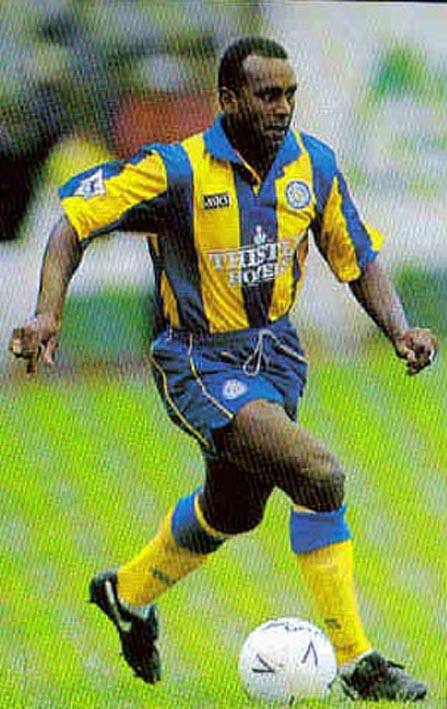
Rocastle: David Carlyle (David)
1992-1993
(Leeds Player Details)(Player Details)
Right Midfield
Born: Lewisham: 02-05-1967
Debut v VfB Stuttgart (a): 16-09-1992
5’9” 11st 1lb (1993)
Rocastle’s rise to the top was rapid, joining the Gunners from Roger Manwoods School in
London as an apprentice in August 1983, turning professional on New Year’s Eve the following
year. The Arsenal faithful immediately took the talented but tough young man, affectionately
known as “Rocky”, to their hearts. Away from the pitch, David was easily one of the most
popular people at the club. Personable, modest, bubbly and cheerful, he was a man who made
time for everyone, and never had a bad word to say about anyone. Rocastle's talent was evident
from an early age and from his initial outings in the first team at Arsenal, it was clear that
he had the makings of future international. Indeed “Rocky” was named Barclay's Young Eagle of
the Year and was a permanent fixture in the England team which was building towards the 1990
World Cup in Italy. Rocastle won two League championship medals with Arsenal. The first came
in 1989, when he played in almost every game. Arsenal's success was sealed when they beat
Liverpool 2-0 in the final game of the season at Anfield, snatching the title from the hosts
on goal difference. But Arsenal were unable to compete in the 1989-90 European Cup because the
ban imposed on English clubs in European competition after the 1985 Heysel tragedy still had
one year to run. Arsenal finished fourth in the 1989-90 league season and missed out on a
return to Europe because only the runners-up were entitled to a UEFA Cup place. In 1990-91, a
knee injury restricted Rocastle to just eighteen League appearances for Arsenal but he still
played his part in Arsenal winning the League championship, as they lost only one League game
all season. The following season he only missed three out of forty-two League games. He also
won a League Cup Winners’ medal in 1987 followed by a runner-up medal the following season.
His skilful forays down the right earned him fourteen caps both at full international, where
he never played on a losing side, and also at Under-Twenty-one level, plus two more for
England “B”. He made his International debut when he he was in the starting eleven for the
England Under-Twenty-One team that drew 1-1 with Sweden in Oestersund on 9th September 1986
in a Friendly. This was followed by a start in a European Championship qualifier in a 1-1
draw with Yugoslavia at London Road, Peterborough when he was replaced after seventy-five
minutes by Garry Parker of Nottingham Forest. His third cap was on 18th February 1987 in
Burgos when England had a fine 2-1 win over Spain in a Friendly and Rocastltle scored his
first International goal when he got the first England goal in the second half. A 0-0 draw
with Turkey in Izmir on 28th April 1987 in another European Championship qualifier was
followed by his first taste of defeat, as West Germany inflicted a 0-2 defeat on England in
a Friendly at Ludenshield on 8th September 1987. Two more European Championship qualifiers
followed in quick succession as Turkey held England 1-1 at Bramall Lane, Sheffield on 13th
October 1987 and then on the 10th November England had a surprising 5-1 win over Yugoslavia
in Zemun and Rocastle got his second International goal, as England finished top of Group 4
to progress to the Finals. He played both legs of the European Championship Quarter-Final
which England won 1-0 at both Pittodrie, Aberdeen, on 16th February 1988 and the City Ground,
Nottingham, on 22nd March 1988. He missed the first Semi-Final against the Eric Cantona
inspired France as they were beaten 2-4 in France, but he was back for the return at Highbury,
but a 2-2 draw was not good enough against the eventual winners, as he gained his tenth cap.
His four remaining Under-Twenty-One caps came as the England captain in the Toulin Tournament.
On 5th June 1988, England beat Mexico 2-1 at Stade Mayol and two days later beat Russia at
Six Fours and completed a perfect round with a 1-0 win over Morocco on 9th June 1988 at Stade
Mayol to progress to the final. They met France at the Stade Mayol three days later and were
again beaten this time by 2-4 after extra time. He made his full International Debut in a 1-0
Friendly win over Denmark at Wembley on 14th September 1988 and a couple of months later, on
16th November 1988, he played his second game at the King Fadh Stadium, Riyadh in a 1-1 draw
with Saudi Arabia. His third cap saw another Friendly victory at the Olimpiako Stadium, Athens
by 2-1 on 8th February 1989. three World Cup Qualifier followed as his caps rose to six, with
a 2-0 win at Qemal Stafa Stadium, Tirana, over Albania on 8th March 1989 and a 5-0 win at
Wembley on 26th April 1989 in the reverse fixture, in which he was replaced after sixty-six
minutes by Paul Gascoigne and then a 3-0 win over Poland at Wembley when he came on as a
seventy-eighth minute substitute for Chris Waddle on 3rd June 1989. Four days later he played
in a 1-1 Friendly draw with Denmark at Parken Stadium, Copenhagen. Two more World Cup
Qualifiers followed, on 6th September 1989 he was a seventy-sixth minute substitute for John
Barnes in a 0-0 draw with Sweden at the Rasunda Stadium, Stockholm, and there was a full game
in the 0-0 draw with Poland at the Stadion Slaski, Chorzow on 11th October 1989. His tenth cap
came in a 2-1 win over Yugoslavia at Wembley, when he started but was replaced by Steve Hodge
after sixty-seven minutes, on 13th December 1989. His eleventh cap was as a substitute for
Chris Waddle, in the seventy-seventh minute of a 1-0 win in a Friendly over Denmark, at Wembley
on 15th May 1990. Then came a 1-1 draw with Poland in a European Championship Qualifier at Lech
Stadium, Poznan, on 13th November 1991. His final two caps were both in friendlies, the first
in a 2-2 draw with Czechoslovakia at the Strahovsky Stadium, Prague, on 25th March 1992, when
he started but was replaced at half-time by Lee Dixon, and finally on 17th May 1992 at Wembley
in a 1-1 draw with Brazil when he came on as a half-time substitute for Trevor Steven. His Two
"B" International caps came in the 1991-92 season, the first on 18th December 1991 in Castellon
against the Spain Olympic XI which England won 1-0. The second was a 1-1 draw with the
Commonwealth of Independent States (C.I.S.) Russia "B", at the Torpedo Stadium, Moscow, on 28th
April 1992. In July 1992, the squad returned for pre-season training. Manager George Graham
told him that Leeds United had made an offer that the Board had reluctantly decided to accept.
They believed that his knee condition was worsening and would increasingly restrict his
mobility and pace, and Graham observed that he had come back from the summer break still
struggling with his weight, as he had been the previous season. In his time at Highbury
Rocastle scored twenty-four goals in two hundred and eighteen League appearances, fourteen of
which were as a substitute. In the Cups he scored ten times in fifty three games, including
three as a substitute and also played nine other games. In fairness to Graham and Arsenal,
they did make Howard Wilkinson aware of Rocky’s condition, but he passed the medical to
Wilkinson’s satisfaction. With Arsenal already having strengthened their midfield, Leeds
seemed the perfect oppurtunity to rebuild his career as the eventual successor to Gordon
Strachan but it proven an unproductive time with United as Rocastle started only seventeen
League games. His sixteen month stay at Elland Road must rank as one of the most curious in
the club’s recent history. In July 1992 the elegant England midfield man became Leeds’ most
expensive signing when he left his first club Arsenal, for £2 million to join the new
Champions. But he could not even get on the bench at the start of the season and that seemed
to set the tone for a miserable spell with the club when he did not see eye to eye with
Manager Howard Wilkinson. Immensely popular with the Leeds fans, they could not understand
his absence from first team duty. He did feature in the European Cup, but did not start a
League game until November when he sparkled in a 3-0 win against his old club. He left for
Manchester City in December 1993, with David White going in the opposite direction in a deal
the two clubs estimated at £2 million. His spell at Maine Road did not solve Rocastle’s
problems and when City snapped up the Swindon Town winger Nicky Summerbee, Rocastle's days at
the club looked to be numbered. For City he scored twice in twenty-one League games and
appeared twice in the FA Cup. By the time “Rocky” arrived at Chelsea from Man City in August
1994 for £1.25 million, his knee problem was common knowledge in the game. However, Chelsea
manager Glenn Hoddle took the view that sixty minutes of Rocastle was worth ninety minutes of
many other players. Hence he started regularly, but was substituted in two-thirds of the
thirty-six games he played that first season. His experience proved invaluable throughout a
European Cup-Winners’ Cup run which ended at the Semi-Final stage. Chelsea lost 1-0 to the
eventual winners, Real Zaragoza. His performance in midfield on a memorable night when a 1-0
deficit against FC Bruges was overturned to send Chelsea through to the final-four, was
probably his finest hour for them, even though he was inevitably substituted with thirty
minutes to go. Sadly, the toll of the injury grew worse and despite spending a further three
seasons on the club's payroll until his contract expired in June 1998, he played just one
more game for Chelsea, against Blackburn Rovers, in October 1995. His full record at
Stamford Bridge was no goals in twenty-nine league appearances, including two as a
substitute. He also scored once in three games in the League Cup and another goal in eight
appearances in Europe, including one from the bench. In 1996-97 after a summer trial at
Hertha BSC Berlin, Rocastle was loaned out to to First Division Norwich at the start of 1997
saw Rocky once again at his creative best, pulling the strings in the middle of the park,
albeit against a lower standard of opposition in an eleven game stay. But, despite a
successful two-month stint at Carrow Road, a permanent deal was never on the cards and he
once again returned to the capital before joining Hull City in Division Three on loan. Rocky
found the net on his debut and made eleven League appearances as well as one in the League
Cup for the Tigers before again returning to Stamford Bridge, seemingly content to see out
the remainder of his lucrative contract in the Chelsea Reserves. On completing his contract
with Chelsea in 1998, Rocastle joined Premier One side Sabah in Malaysia. Living on the
island of Borneo with his young family, David was the ideal foreign signing. He fitted the
style of a true ambassador, down-to-earth, a team player, but nevertheless, as far as the
Sabah fans were concerned, a world-famous player from the Premiership. Joining mid-season
in 1998, Rocastle helped Sabah reach the 1998 Malaysian FA Cup Final, losing to Johor by a
single dubious goal, and also the semi-finals of the Malaysian League Cup. The 1999 season
saw Sabah finish a satisfying fourth in Premier One, reaching the semi-finals of the
Malaysian FA Cup and the Final of the 1999 President Cup, which proved to be David’s last
competitive match. He returned to the UK at the end of the 1999 Malaysian playing season,
and announced his retirement. In February 2001, Rocastle announced that he was suffering
from non-Hodgkins’ lymphoma, an aggressive form of cancer which attacks the immune system.
He underwent a course of chemotherapy for the illness and was hopeful of a recovery. But
he died in Slough on 31st March 2001, aged thirty-three. His brother Stephen was on the
books of Norwich City and his cousin Craig played in midfield for Port Vale.