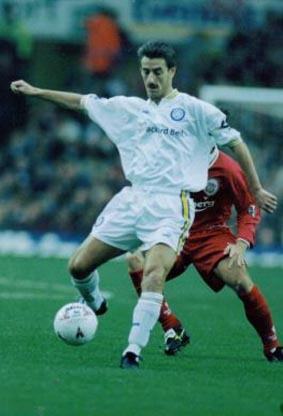
Rush: Ian James (Ian)
1996-1997
(Player Details)
Centre Forward
Born: St Asaph Wales: 20-10-1961
Debut v Derby County (a): 17-08-1996
6’0” 12st 6lb (2000)
After leaving St Richard Gwyn Catholic High School, Flint in 1978, Rush began his career
with Third Division Chester City. After impressing in the youth ranks, he went on to play
thirty-four League games and score fourteen goals after making his debut in April 1979. He
played in midfield on his debut, but established himself as a potent centre forward the
following season. After the sale of regular centre-forward Ian Edwards to Wrexham he became
a regular and a couple of months later Rush's reputation was enhanced by scoring for Chester
in a shock 2-0 FA Cup Third Round win at Newcastle United in January 1980, with Chester
equalling their best run by reaching the last sixteen where they narrowly lost to Ipswich
Town. His final game for Chester was a 2-1 win over Southend United at Sealand Road on 26th
April 1980, in which he did not score. Despite interest from Manchester City, and in spite
of Rush being a boyhood Everton fanatic, Liverpool had won the race to sign the eighteen-year
old. Manager Bob Paisley paid a record fee for a teenager of £300,000. It remains Chester's
record sale even twenty-eight years later. Rush was managed throughout his time at Chester by
Alan Oakes, although much of the credit for his development is given to youth manager Cliff
Sear. Nearly twenty years later, Rush and Sear worked together on the coaching staff at
Wrexham. Rush had actually made his international debut, in May 1980, just before he
officially became a Liverpool player. Rush was used sporadically during his first season at
the club as Liverpool had a policy of bringing in young talent and playing them in the
reserves to learn 'the Liverpool way'. Rush was treated no differently and had to serve his
apprenticeship as a squad member rather than being thrown into the first team. This learning
period was hard and not at all 'Rush-like', as the goals didn't flow, almost leading to the
eager youngster leaving Anfield in the search of regular first-team football. But after a
talk with the very shrewd Paisley, who told him to "be more selfish in front of goal", Rush
decided to stay and fight for a place. Rush's first goal for the club took time to arrive,
but it eventually came on the 30th September 1981 during an Eurpean Cup First Round Second
Leg tie at Anfield against Oulun Palloseura. Liverpool had already won the Away Leg 1-0, and
the Second Leg proved to be a formality as they trounced the Finnish team 7-0, Rush scoring
in the sixty-seventh minute after coming on three minutes earlier for David Johnson. He ended
the season as the club's top scorer, netting thirty times in just forty-nine appearances in
all competitions. Seventeen of these goals came in the League as he helped the Reds reclaim
the League Championship from holders Aston Villa. He was voted PFA ‘Young Player of the Year’
in 1983 after inspiring Liverpool to glory in the League championship and League Cup. He
scored twenty-four League goals as the Reds finished eleven points clear of runners-up
Watford and were virtually uncontested in the title chase in the later part of the season.
The League Cup was added through a 2-1 win over bitter rivals Manchester United after extra
time at Wembley. He was voted PFA Player of the Year in 1984 as Liverpool retained both the
League and the League Cup and won the European Cup to complete a unique treble that season.
It was no surprise that Rush also added the Football Writers’ ‘Footballer of the Year’ to
the PFA award he had already claimed. He won Europe's Golden Shoe for scoring forty-seven
goals, more than anybody else on the continent, in sixty-five games, as Liverpool finished
three points clear of closest rivals Southampton in the League, beat ‘derby’ rivals Everton
1-0 in the replayed final of the League Cup, after a 0-0 draw in the first ever
all-Merseyside final, and won their fourth European Cup by defeating AS Roma 4-2 on
penalties, following a 1-1 draw after extra time. The 1984-85 season was Liverpool's first
trophyless season in ten years, although they did reach their fifth European Cup final
against Juventus at the Heysel Stadium, Brussels in Belgium. This final was to end in
disaster as, before the match kicked off, rioting football hooligans caused a retaining wall
to collapse, killing thirty-nine Juventus supporters. The game was surprisingly required to
be played in spite of this terrible tragedy. The game, with both teams not totally committed
or fully caring about the result, ended in a 1-0 win for Juventus. Liverpool were beaten to
the title by neighbours Everton, who were crowned champions with four matches to spare. The
1985-86 campaign was much better for the Reds and Rush. He scored twice as Liverpool beat
Southampton 2-0 in the FA Cup Semi-Final at White Hart Lane, booking a place at Wembley to
face neighbours Everton in the first all-Merseyside FA Cup Final. The Reds had just pipped
their city rivals to the League title by beating Chelsea 1-0 at Stamford Bridge, so the
already monumental final was doubly important for both sides. If the Reds won, it would make
them the fifth team to have won the double. If Everton won, not only would they stop their
arch rivals from completing the double but also win the major trophy that their football had,
in many eyes, deserved. The Blues scored first through Gary Lineker and held the lead until
half-time as Liverpool struggled to find their usual rhythm. But after the half-time team-talk
by the now player/manager, Kenny Dalglish, Liverpool looked a different side in the second
half. With Rush leading the line brilliantly, they drew level in the fifty-seventh minute
when he latched onto a defence splitting pass from Jan Molby to round Everton goalkeeper
Bobby Mimms and slot the ball into an empty net. Six minutes later, Molby was again at the
heart of another attack and drilled a perfect cross for Craig Johnston to score. Liverpool
were now 2-1 up, but the game was in the balance until the eighty-fourth minute. Dalglish
made a run across Whelan’s path into space, but Whelan used it as a dummy and clipped an
exquisite ball over three Everton defenders into the path of Rush who, from the angle of the
six-yard area, thumped the ball past Mimms, knocking over a camera in the process. Liverpool
held on to win 3-1 and completed the first League-FA Cup double in the club's history. Rush
added the Man of the Match award to his winner's medal. Not only was Rush becoming one of
Liverpool's all-time greats, but after making his International debut for wales in a 0-1
loss to Scotland at Hampden Park on 21st May 1980 he had also made himself indispensible as
the main striker fror his country. After scoring his first goal in a 3-0 win over Northern
Ireland at Wrexham on 27th May 1982 he went on to score in each of the next four games and
by the time he had made his move to Italy he had scored fourteen times in thirty-two games
in the Red shirt of Wales. Rush had decided early in the 1986-87 season that he would be
leaving Anfield, and on 1st July 1987, he was transferred for £3 million to the Italian giants,
Juventus. The move was seen by many as a deal to help the healing process after Heysel and to
re-open friendly links between the clubs. However it was viewed, it was a new challenge for
Rush, who would have the task of unlocking the much tighter defences in the Serie A.
Unfortunately, his time at Juventus was less than successful, as he scored only seven times
in twenty-nine games. "The Ghost" only spent one season with Juventus, but returned a better
all-round player. He struggled to find a way through the deep-lying Italian defences and,
unlike fellow Welsh football legend John Charles, did not settle easily into the Italian way
of life. He allegedly used to request food parcels of baked beans to remind him of home. He
would also spend the rest of his life kicking himself for delivering the unforgettable quote
that he found Italy “just like a foreign country.” While in Turin he had continued as the main
Welsh spearhead at international level scoring twice in six games in that time which was
finalised as he scored the only goal of the game as Wales defeated Italy in Brecia on 4th June
1988 and he had been captain of Wales in that game and the previous one against Malta.
Nonetheless, despite his relative drought while in Italy, the goals started flowing again on
his return to Liverpool and Rush enjoyed a further eight years of headline making. He returned
to Anfield, rejoining Liverpool for £2.7 million on 18th August 1988, a record signing for an
English club at the time, which remained unbroken for three years. The news of Rush's imminent
return was given to Liverpool fans before they journeyed south to London for yet another
Charity Shield match. Before the game started, they were in full voice. However, this time
they had a new song: "Rushie is back, Rushie is back". Although the Liverpool team of 1987-88
had played some outstanding football, such was Rush's stature with the Liverpool fans, they
were pleased to see him return to the club. Rush had serious competition for the striking
berth alongside Peter Beardsley and John Aldridge, who came to Anfield as a replacement for
Rush. It was deemed that the pair were too similar in style to be able to play together.
Aldridge started the season in front of Rush and consistently scored goals, thus keeping the
Welshman on the bench. As the season progressed, Rush came into some form. Rush had again
scored twice against Everton in a thrilling 3-2 win in the 1989 FA Cup final. He came off the
bench to replace Aldridge, who had opened the scoring for Liverpool in the fourth minute of
the game. The sides were locked at 1-1 after ninety minutes, but Rush put the Reds ahead in
the fourth minute of extra time. Everton midfielder, Leeds-born, Stuart McCall then scored his,
and the Toffees', second equaliser, but Rush came up with the goods once more with an incisive
finish in the one hundred and third minute to win the Cup for Liverpool. The 1989 FA Cup final
carried even greater significance because of the events of 15th April 1989. In the semi-final,
Liverpool had been drawn against Nottingham Forest at Hillsborough. However, the game was
brought to an abrupt end at 3.06pm due to the unfolding disaster. Ninety-six Liverpool fans
were killed in what was to be a life-changing experience for everyone involved. The players
and staff of Liverpool Football Club, including Rush, were commended for their exemplary
behaviour during the darkest days in the club's history. Everton fans were immensely
supportive of their neighbours during this bleak period and the fact that Liverpool would meet
their side in the Wembley final made for the perfect match. The fans once again stood side by
side in their blue and red colours and did the city and people of Liverpool proud, as did the
players and officials of both clubs.The 1989/90 season saw Rush win another League title, his
fifth and last, as Liverpool finished nine points clear of Aston Villa, with Rush scoring
eighteen times in thirty-six games. However, another bid for the League-FA Cup double failed
as the Reds suffered a shock FA Cup semi-final defeat to Crystal Palace, even though Rush had
given the Reds a fourteenth-minute lead.In 1992, he picked up a third FA Cup Winners' medal,
scoring Liverpool's second goal, in the sixty-seventh minute, in the 2-0 win against
Sunderland at Wembley. In the League, injuries restricted him to just eighteen League games
and three goals that season. However, his third goal came in a crucial 2-0 home win over
Manchester United on 26th April 1992, which denied their arch-rivals the championship, the
title going instead to Leeds United. The greatest goalscorer in Liverpool's history, Ian
Rush broke Roger Hunt's record by scoring his two hundred and eighty-seventh goal against
Manchester United on 18th October 1992 and it is hard to see anyone catching up with him in
the future. Souness made him captain in the 1993-94 season and he became mentor to Robbie
Fowler. Rush picked up his fifth League Cup winners medal in 1995, when two goals from Steve
McManaman ended Bolton Wanderers’ dreams of a shock result, Liverpool running out 2-1 winners.
His long association with the Reds ended with a substitute appearance in the 1996 FA Cup
final against Manchester United. In a hugely disappointing game lost 0-1, but he had earlier
that season on 6th January 1996 scored his forty-second goal in the FA Cup, breaking one more
record. For the record his time at Liverpool had been littered with trophies and medals. In
his two spells at Anfield in four hundred and seventy-one League games, including twenty-two
from the bench, he scored two hundred and twenty-nine goals. In the FA Cup he scored
forty-four goals in sixty-five games, eight being as a substitute. In the League Cup he
scored forty-eight times in seventy seven appearances. In European Competition he scored
nineteen times in thirty five starts and another two from the bench. In other games such as
the Charity Shield, Super Cups and recognised competitions he played a further fifteen games
scoring ten times. In a large house on the Wirrall, a trophy cabinet groans under the weight
of its glittering contents. They tell the story of a player who broke all goal-scoring
records in the FA Cup, matched Geoff Hurst’s record in the League Cup, won five Championship
medals, in 1981-82, 1982-83, 1983-84, 1985-86, 1987-88 and 1989-90, three FA Cup Winners’
medals in 1985-86, 1988-89 and 1989-90, five League Cup Winners’ medals in 1980-81, 1981-82,
1982-83, 1983-84 and 1994-95, two European Cup Winners’ medals in 1980-81 and 1983-84 and a
Golden Boot. After representing Wales as a schoolboy and twice at Under-Twenty-one level, a
measure of his ability is his scoring prowess for Wales. A record twenty-eight goals in
seventy-three appearances, none more memorable than his truly heroic winner against the
mighty West Germany in a 1991 European Championship Qualifying match at Cardiff. After such
an illustrious career he was given a free transfer by Liverpool and allowed to negotiate his
own terms with Leeds United, who he joined on 20th May 1996. There were high expectations of
the almost thirty-five year-old from the Leeds fans. Unfortunately they were to be sadly
disappointed as was Rush. Howard Wilkinson, who had signed him, was quickly given the sack
after Leeds got off to a dismal start. His successor, George Graham, in turning round Leeds
fortunes employed tactics totally unsuited to Rush’s game and his form suffered accordingly
and soon he found himself playing in midfield rather than in his striking role. Rush spent
a season with the Leeds but scored just three times in thirty-six Premiership games and was
given a free transfer at the end of the 1996-97 season as Graham showed he did not figure
in his plans by allotting him and other players, Tomas Brolin, Tony Yeboah and Tony Dorigo,
non-essential to Graham’s plans for Leeds shirt numbers in the high thirties and left them
to train with the juniors. It was a sad and disappointing end to his Leeds Career for when
he had joined them he had high hopes of it being a bridge to coaching and management. Prior
to signing the contract with Leeds he had had offers from Manchester City and Sunderland.
But in discussions with Leeds, the subject of replacing Howard Wilkinson as manager came up.
He was told that Wilkinson would groom him for a couple of years, and then stand aside. Rush
liked the sound of that. In his biography he commented “What made the offer so appealing
was that I would understudy Howard with a view to succeeding him as manager within two to
three years.” “My aim was to work towards gaining the UEFA Pro Licence. I felt I’d learn a
lot under Howard who was widely respected throughout the game. For me, his greatest
achievement was the youth policy he instigated at Elland Road.” Unfortunately for Rush,
within months of his move from Merseyside to Yorkshire, Wilkinson was sacked. Leeds
appointed George Graham who, with due respect to Rush, was not about to school a potential
replacement. Nor was he inclined to use tactics or formations which centred around the
striker or played to his strengths. Rush's record as a goalscorer spoke for itself and he
expected Graham to appreciate that but United’s boss was his own man and asked Rush to run
the right side of midfield. “It quickly became apparent that I didn’t figure in his plans,”
Rush said. “He took me to one side soon after taking over and asked me to do him a favour.
Would I play wide on the right in midfield? Just for one match. He was asking me to play
out of position but I felt a responsibility to the team and the club. I was skipper at the
time and it was only for one match. Four months later I was still playing wide on the right
and still not scoring the goals I was signed for.” Three goals in forty-two appearances
ruined his goalscoring reputation. Rush and other senior players were eventually made to
train with United’s juniors as Graham began to restructure his squad. Tony Yeboah became
an outcast too. One Thursday night, Rush turned out for United’s reserves in a game against
Halifax Town at The Shay. The following day after a phone call from Kenny Dalglish, a
transfer to Newcastle United materialised, much to his surprise. “I hoped for a break and
here it is,” he said after bailing out of Elland Road with haste. “This is a great chance
to show I can still look sharp and score goals in the Premiership.” Newcastle did not see
that side of him either. Unsurprisingly, he joined Newcastle United on a one-year contract
but lost his place in the side after Christmas, when Alan Shearer returned from a long-term
injury. He failed to score in ten League games, four of which were as a substitute, however,
Rush did score an important goal in a 1-0 win over Everton in the Third Round of the FA Cup,
his forty-third in the competition, a Twentieth Century record. He had a loan spell with
Sheffield United later in the season, not scoring in four League games, before leaving
St James's Park in the summer of 1998 to sign, amid much fanfare, for Wrexham. The
thirty-seven-year-old Rush failed to score in seventeen Division Two games, of which five
were from the bench, for the North Wales club, and was moved into midfield towards the
end of the season. He made a brief playing comeback with Sydney Olympic in Australia,
scoring once in two appearances, before finally retiring, aged thirty-eight, in 2000.
After working as a part-time striker's coach for Liverpool under Gerard Houllier in 2003,
he was appointed manager of his first professional club, Chester City, by this time in
League Two, in August 2004. Chester had made a dreadful start to their first season back
in the Football League but Rush and assistant manager, former Leeds captain, Mark
Aizlewood enjoyed a good start to their time at the helm. After losing 3-1 at Boston
United in their first game in charge, they strung together a two month unbeaten run and
led the club to the FA Cup Third Round. Rush seemed to be answering his critics, who
doubted whether his tactical and coaching abilities could match his striking history. But
after Rush loyally ruled himself out of the running for the vacant Welsh manager's job on
1st November 2004, things never seemed to go as well. Several heavy defeats were
inflicted and Rush was criticised for the physical and long-ball tactics his managerial
team opted to use. Despite pressure from the Chester chairman, Rush refused to resign
after a humiliating 5-0 loss to neighbours Shrewsbury Town in February 2005. But when
Vaughan sacked Aizlewood in April, Rush resigned on principle with Chester safe from
relegation. Rush was interviewed for the Peterborough United manager's job shortly after
this, but lost out to his predecessor as Chester manager and former Liverpool team-mate
Mark Wright. In 2005, at the age of forty-three, Ian Rush considered coming out of
retirement to play for TNS, after the Welsh side were drawn against Liverpool for their
opening round ECL qualifying match, but later decided against this. From November 2005,
Ian Rush became involved in media work within the game, including a stint as an analyst
with ESPN. He also appeared as a pundit and reporter for Sky Sports. Rush was inducted
into the Football Hall of Fame in 2006 due to his achievements in the game. On 7th
September 2007 it was announced that Rush had been appointed Elite Performance Director
for the Welsh Football Trust, a part-time role in which he will help develop the next
generation of players for Wales' national teams. Rush released his autobiography on 21st
August 2008. On 26th April 2010, Rush returned to work with Liverpool FC, becoming the
Club's new Soccer Schools Ambassador working with the Club's commercial team to help
develop and support partnerships with other global sponsors and brands.