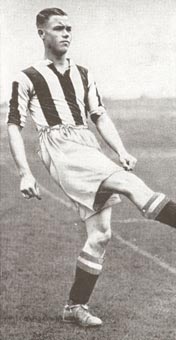
Steele: Frederick Charles (Freddie)
WW2 Guest: 1943-1944
(Leeds United War-time Guest Player Details)
Centre Forward
Born: Hanley: 06-05-1916
Debut: v Chesterfield (h): 08-04-1944
5'9" 11st 8lb (1936)
After playing with Downings Tileries, Freddie Steele was signed for Stoke City in 1931,
aged fifteen, by Manager Tom Mather. He carried out work in the club's offices, until he
was old enough to turn professional. He signed professional forms in August 1933 and made
his debut in December 1934. Nicknamed "Nobby" by fans, Steele was a prolific goal-scorer
for Stoke, scoring two hundred and twenty goals in three hundred and eighty-four games in
his time at the club. He was not very prolific in his initial seasons with the club as he
scored once in nine League gamesin his first season of 1934-35 and eight goals in the
League from twenty-nine appearances and three more in four F.A. Cup games. However, as he
gained experience in the First Division and moved from his teenage years into his twenties
he became far more prolific, starting with thirty-three goals from thirty-five League
appearances and thre goals in two games in the F.A. Cup in 1936-37. It was helped along
when he scored five goals in Stoke's record score of 10-3 over West Bromwich Albion on 4th
February 1937 at the Victoria Ground. Steele's thirty-three league goals in 1936-37 remains
a club record to this date. His form was such that he forced his way into representative
honours. He was selected for the Football League at Windsor Park, Belfast and scored in a
2-3 defeat by the Irish League on 23rd September 1936 and then was capped six times for
England and scored eight goals. He made his International debut at Centre Forward on 17th
October 1936 at in a 1-2 defeat by Wales at Ninian Park, Cardiff. He got his second cap on
18th November 1936 at Centre Forward on his own Victoria Ground at Stoke as England beat
Northern Ireland by 3-1. His third cap brought his first International goal on 17th April
1937 as he opened the scoring after forty minutes, but it did not stop Scotland winning
3-1 at Hampden Park Glasgow in front of 149,547 rabid Scottish spectators. He grabbed two
second half goals in his fourth International as England beat Norway 6-0 on 14th May 1937
at the Ullevaal Stadion in Oslo and there were three goals for him inside thirty-three
minutes, as England won in the Rasunda Idrottsplats, in Solna, Stockholm against Sweden
three days later. His sixth and final cap came at Inside Left in an 8-0 win by England
over Finland in the Toolon Pallokentta, Helsinki on 20th May 1937, which saw Steele score
twice, one in each half with England’s third and fifth goals. He also played one more time
for the Football League, in a 0-1 defeat by the Scottish League at Hampden Park on 22nd
September 1937. However, a knee injury sidelined him in 1937 and he struggled to recover
from it and this meant that he did not represent his country again, but he still managed
fifteen goals in twenty-three League games in the 1937-38 season. He decided to retire in
1939, aged twenty-three. However, he opted to return to the game, scoring ten times in
five matches upon his return and in that final season before the war he netted twenty-six
in thirty-one League games and one in two F.A. Cup games. The outbreak of World War Two
then halted his progress, as the Football League was suspended. During the war Steele
still played mainly for Stoke, but also included a spell as a guest player at Arsenal,
Bradford Park Avenue, Doncaster Rovers, Fulham, Leicester City, Northampton Town,
Nottingham Forest, Notts County, Sheffield United and a couple of games for Leeds United.
He never failed to score for any of the clubs he played for in that time. He played two
games for Leeds in April 1944 and scored twice in the 1943-44 Football League Northern
Section Second Championship. He made his Leeds debut on 8th April 1944 at Inside Left in
1-0 home win over Chesterfield and Steele got the only goal of the game. He returned three
games later in the final game of the campaign against Halifax Town at The Shay and although
Steele got the first Leeds goal they went down 2-5. With Stoke he scored three goals in
five games in 1939-40, five in sixteen games in 1940-41, one in eight games in 1941-42,
twenty in just nine games in 1943-44, ten in seventeen games in 1944-45 and thirty-six in
thirty-six games in 1945-46 and a further seven in eight games in the F.A. Cup of that
season. Sixty-five goals in ninety-one games. He started guesting with Notts County in
1939-40, scoring once in two games and returned in 1942-43 and scored twice more in five
games. In 1940-41 he scored once in his only game for Sheffield United and five times in
seven games for Leicester City, who he returned to in 1943-44 and scored thirteen in eleven
appearances. 1941-42 saw him guested with Northampton Town, scoring twice in four games and
Nottingham Forest where he scored in his only game and he returned to Forest in 1943-44 to
score in his only game for them in that season. He scored five times in five games for
Bradford Park Avenue in the 1942-43 seaon but he also scored four goals in five games for
Doncaster Rovers in that season and when he returned to Belle Vue the following season he
netted twelve times in fifteen games. The 1944-45 season saw him in London where he scored
six goals in eleven games for Arsenal and twice in his only game for Fulham. He returned to
Stoke City in 1945-46, scoring forty-nine goals in forty-three games during the course of
the season. In April 1946 Steele was apponted manager of Icelandic club KR Reykjavík. They
won three of their five games under his charge to finish runners-up for the season. He was
then appointed manager of the Iceland national team for its first ever international match
against Denmark on 17 July 1946. After they were defeated 0-3, Steele left on 17 August 1946,
and returned for the start of the new Stoke season. The first post war season of 1946-47 saw
him back to his old prolific best, with twenty-nine goals in thirty-eight League games and
two more in five F.A. Cup games. This was followed by ten goals in twenty-one League games
and two in two F.A. Cup games and in his final season at Stoke there were eighteen goals in
thirty-eight League games and one in four F.A. Cup ties. He left the club in June 1949, due
to persistent knee problems. Roy Goodall had resigned as manager of Mansfield Town and
returned to his former club, Huddersfield Town. By now Steele was thirty-three but he was
signed as player manager to replace Goodall for the start of the 1949-50 season. The Stags
opened the season with six wins and four draws before first tasting defeat, Steele having
scored seven goals in those games. The record could not be sustained but they did finish
eighth in the Third Division North and Steele scored eighteen goals in twenty-two games and
scored once in two F.A. Cup ties. The 1950-51 season was judged as one of the club's best
ever. They went through the season undefeated at Field Mill and were narrowly pushed into
second place by Rotherham United, who finished Champions. Steele had scored fourteen in
nineteen League games and four more in the club's fine F.A. Cup run, in which he had played
six games. The Stags had an easy passage in the first two rounds when Non-League sides,
Walthamstow Avenue, who were beaten 1-0 at Field Mill, and Chelmsford City, who were beaten
4-1 on their own ground, were the opposition. The Third Round saw a 2-0 home win over Second
Division Swansea Town. A trip to Bramall Lane, before a crowd of 48,696, saw then draw 0-0
with their Second Division opponents saw a record Cup crowd of 20,314 at Field Mill to
witness a 2-1 win. Once more the draw was not kind to them and it was another away trip, to
Bloomfield Road, to play First Division Blackpool. A 0-2 scoreline saw the end of the dream
as the seasiders carried on to the Final at Wembley, where they too were beaten 0-2 by
Newcastle United. There was high hopes of promotion in the 1951-52 season, and after a good
start it was looking good, but after being knocked out of the F.A. Cup, by Non-League
Stockton, in the First Round, things deteriorated and Steele resigned to take up a similar
position with Port Vale just before Christmas. He had scored thirty-nine goals in fifty-three
League games. Once more he was successful, taking them to Third Division North runners-up in
1952-53 before winning the Third Division Championship and guiding the club to the Semi-Final
stage of the FA Cup in 1953-54. He finished his playing days in 1952, having scored seven
goals in fourteen League games in the 1951-52 season and five goals in eleven in the following
season for a total of twelve goals in twenty-five appearances in all games with Port Vale. In
many ways Steele was a unique player for not only could he score with his feet, but also
amassed an impressive tally of headed goals. Though only five foot ten inches tall, he could
spring into the air, tilt his head back and then nod the ball back at a which prompted many
goalkeepers to profess that he could head the ball harder than some players could kick. He
also boasted a tremendous turn of pace. His speed over a couple of yards was uncontested and
took him quickly away from most defenders. He represented Staffordshire as a hurdler and the
4 x 100 yards relay. He still holds the Stoke City record of goals in the Football League,
with one hundred and forty goals and the recors for goals in the F.A. Cup at nineteen goals,
despite John Ritchie holding the overall record in all games in peacetime. His managerial
tenure at Port Vale came to an end on 15th January 1957, when after a series of poor results,
he resigned. He did return for a second time when he replaced Norman Low in October 1962. He
stayed for almost two and a half years before once more resigning as the Valiants were
looking certainties for relegation in February 1965.He died in Newcastle-under-Lyme on 23rd
April 1976, aged fifty-nine.