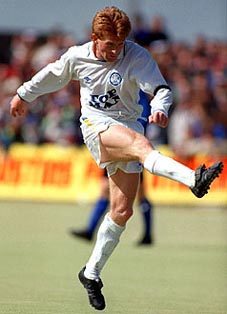
Strachan: Gordon David (Gordon)
1989-1995
(Player Details)
Right Midfield
Born: Edinburgh: 09-02-1957
Debut v Portsmouth (h): 25-03-1989
5’6” 10st 3lb (1989)
#5 in 100 Greatest LUFC Players Ever
Outside Right in Greatest LUFC Team
Strachan enjoyed a top-level career on both sides of the border both in playing and
football management careers. A Hibernian supporter from an early age, he was a pupil at
Silverknowes Primary School when he started to show signs of football promise and this
blossomed as he carried on to Craigroyston Secondary, and his local Edinburgh club,
Edinburgh Thistle. He first represented Edinburgh Schoolboys and was then selected three
times fror the Scottish Schoolboys representing Scotland against England, both in a 1-1 draw
at Ibrox Park, which saw Ray Wilkins get the equaliser to an Arthur Albison penalty and a
4-2 win at Wembley, and in between, featuring in a thrilling 4-4 draw with West Germany at
Saarbrucken in front of a crowd of 40,000. Eddie Turnbull had just taken over the reins at
Easter Road and it just seemed a formality that Strachan would sign for the club that he had
been an avid supporter from childhood. However, Turnbull had reservations about his height
and also resented the fact that the club had agreed to supply what he considered was an
expensive pair of Adidas football boots. Strachan's father stuck to his guns and so did
Turnbull and the chance was gone. It was not that Strachan was starved for choice, he also
turned down Manchester United. Dundee had been following his progress but on hearing of
Turnbull's failure to sign the young protege they quickly moved in, and signed him as a
schoolboy in October 1971. Initially he remained at Craigroyston and after school would make
the one hour train journey to Dundee to train at night but after leaving school he became a
full time member of the Dundee ground staff and took the morning train along with other
Edinburgh-based Dundee players. The sixteen year-old was quickly becoming noticed and won
the Scottish Reserve player of the Year in 1973, as Dundee won the League Cup by beating
Celtic. The sixteen year-old Strachan was given his first game as a substitute in a home
Drybrough Cup game with Raith Rovers on 29th July 1973, which Dundee needed extra-time to
win 1-0. There was another substitute appearance two weeks later in the League Cup in a 1-0
home win over St Johnstone, but it was not easy for the young Strachan to break into the
strong Dundee side which won the League Cup in 1973-74. He was playing well in the Dundee
Reserves and once more won the the Scottish Reserve player of the Year in 1974 and was
selected for the Scottish Youth team. It took an outstanding performance in an August
friendly at Dens Park to further the claim of the eighteen year old. Arsenal were beaten 2-1,
with Strachan outplaying Alan Ball in midfield. That season saw the start of a new ten-team
Premier Division competition, but despite Strachan scoring six goals in seventeen League
starts, and six more from the bench, he was unable to stop them being relegated to Division
One. He was almost an ever-present in the 1976-77 season and scored seven goals from
thirty-three starts and three more from the bench, but Dundee had to be content with third
place. His influence was such that he was appointed club captain, athough only just twenty,
for the start of the 1977-78 season. He was called up into the Scotland Under-Twenty-one
squad on 7th September 1977 but but did not make the final team. He was also on the radar of
several other clubs and after he had an outstanding game for Dundee in a 1-1 home draw with
Hearts on 29th October 1977, the financially challenged Deesiders could not refuse an offer
of £50,000 from Aberdeen and he left for Pittodrie in early November. He had scored thirteen
goals in sixty-nine Scottish League games, of which thirteen had been from the bench. He
also score once in seven Scottish Cup starts, once in thirteen Scottish League Cup ties, of
which two were as substitute, and had started the friendly with Arsenal and come on as a
substitute in the Drybrough Cup, without scoring. At Pittodrie he became a vital part of the
team that broke the dominance of the two Glasgow sides in the 1980s. He won two Scottish
League Championship medals, in 1980 and 1984, a hat-trick of Scottish Cup-winners’ medals,
from 1982 to 1984, and a European Cup-Winners’ Cup medal in 1983 and the European Super
Cup in the same year. He also played in the 1979 Scottish League Cup Final and was Scottish
Player of the Year in 1979-80. He made his debut for the Dons in the Scottish Premier League
on 5th November 1977 in a 1-0 win over Dundee United at Tannadice Park but initially it was
not obvious that Billy McNeill had pulled of one of the biggest bargains in modern football.
At first Strachan found it hard to establish himself in the strong and highly competitive
Aberdeen side and his confidence ebbed as poor form and injuries in the 1977-78 season saw
him score just once in ten starts and two games from the bench in the League and he was not
selected in Aberdeen's Scottish Cup Final defeat by Rangers. At the end of the season McNeill
left for Celtic and Alex Ferguson took over. Strachan was able to impress the new manager and
soon established himself as a first-team regular, scoring five times in twenty-six starts and
five games from the bench in the League. By the start of the 1979-80 season he had established
himself as one of the best midfielders in the business and the season saw him reap the rewards
as Aberdeen won the Premier Division Championship and Strachan himself was rewarded with
his first Scotland Under-Twenty-One Cap in a 1-0 win over Belgium at the Freethiel Stadium in
Bevern on 20th November 1979 in the UEFA Championships. It was to be his only cap at that
level as he was called up to the Scottish full squad for the Home Championships at the end of
the season in which he scored ten goals in thirty-three starts as Aberdeen pipped Celtic by
one point, with a dynamic finish to the season in which they reversed a ten point deficit on
leaders Celtic, including twice beating them at Parkhead. He made his International debut on
16th May 1980 in a 0-1 loss to Northern Ireland at Windsor Park, Belfast. This quickly became
five as he again started in a 1-0 win over Wales five days later at Hampden Park and three
days after that at the same venue he was in the team beaten 0-2 by England. He then joined
the squad for the close season tour of Europe starting in the 0-1 defeat by Poland at the
Warta Stadium, Poznan on 28th May 1980 and three days later he came on as a substitute at
the start of the second half for Alan Brazil in a 1-3 defeat by Hungary at the Nep Stadium,
Budapest. While the results were not so good for Scotland it did showcase the skills of the
now twenty-three year old Strachan as they looked towards the World Cup qualifiers. Strachan
signed a four year contract to keep him at Pittodrie until 1984, but while Alex McLeish also
stayed, Steve Archibald left for Tottenham Hotspur for £750,000. Aberdeen were unable to
repeat their championship feat in 1980-81 and finished second to Celtic, and had the
misfortune to come up against Liverpool, the eventual winners, in the second round. Strachan
scored six goals in twenty League starts as he missed the second part of the season after
tearing a stomach muscle. He did, however, add two further caps to his collection. He scored
his first international goal in the seventy-third minute of the game at the Rasunda Stadium in
Solna on 10th September 1980 to give Scotland a great start to their World Cup campaign to
reach the Finals in Spain in 1982 with a 1-0 away win. On 15th October there was a goalless
draw with Portugal at Hampden Park, but his injury precluded him from adding any further for
the time being. He was back in the Aberdeen side for the start of the 1981-82 season, in
which he scored seven goals in thirty League starts and saw Aberdeen once more runners-up
to Celtic in the title race, by a mere two points, but this time they finally won the Scottish Cup,
with Strachan getting the vital third goal in the thirteenth minute of extra time as they beat
Rangers, at Hampden Park on 22nd May 1982, by 4-1, after extra time. Strachan also
established himself as a Scotland regular, after returning from injury in October 1981 with
Scotland already assured of a place in the World Cup Final. He started in the 0-0 draw with
Northern Ireland at Windsor Park, Belfast, on 14th October 1981, but was replaced by Andy
Gray with twelve minutes on the clock and there was a full game in the 1-2 loss to Portugal
at the Stadium of Light in Lisbon on 18th November 1981. There were two friendlies leading
up to the World Cup Finals. In the first, Strachan started but was replaced by Steve Archibald
after sixty-eight minutes at the Luis Casanova Stadium in Valencia as Scotland were beaten
by Spain 0-3 on 24th February 1982, while in the second he came on as a substitute for Joe
Jordan with four minutes to go as Scotland beat the Netherlands at Hampden Park on 23rd
March 1982. He received many accolades from the media as he took his caps to fourteen as
he started all three of Scotland's group games, giving virtuoso performances as they were
eliminated on goal difference. On 15th June 1982 at La Rosaleda Stadium, Malaga, in a 5-2
win over New Zealand he played until the eighty-fourth minute when he was replaced by David
Narey, then three days later at the Benito Villamarin Stadium in Seville they were beaten 1-4
by Brazil and he was replaced by Kenny Dalglish after sixty-six minutes and finally, four days
later, in the vital decider with USSR, again at La Rosaleda Stadium, Malaga, he was replaced by
Danny McGrain after seventy-four minutes as Scotland drew 2-2. His continuing influence at club
level was as strong as ever as Aberdeen began to establish themselves in the top echelon in
Europe. Their 1983 European Cup Winners' Cup triumph was the zenith of their Continental
achievements. The 1982-1983 season saw Strachan score twelve goals in thirty-two League
games as they dropped to third in the Premiership but only finish just one point behind
champions Dundee United. However, they once more won the Scottish Cup by defeating Rangers
1-0, after extra time, in the final at Hampden Park on 21st May 1983 with an Eric Black goal four
minutes from the end of extra time. While Strachan had started the season like a house on fire
scoring seven times in the group stages of the League Cup, including four in one game in a 5-1
win over Dundee, they were eliminated by Dundee United. However, it was in the European Cup
Winners' Cup that the team really shone as Strachan scored once and played in ten of the eleven
ties as Swiss side Sion were disposed of 11-1 on aggregate in the Preliminary Round, followed by
Albanian team Dinamo Tirana by a single goal and Poland's Lech Poznan 3-0 to give Aberdeen a
Quarter Final tie with Bayern Munich. They duly held the Germans goalless in the away leg before
winning 3-2 at Pittodrie, before a 5-2 aggregate win over Belgian side Waterschei put them in the
Final against Real Madrid at the Gamla Ullevi Stadium in Gothenburg on 10th May 1983 where
they won 2-1 after John Hewitt got the the decider eight minutes from the end of extra time after
it had been 1-1 at full time. They went on to win the 1983 European Super Cup Final, when they
beat Hamburg SV, the European Cup Winners in a two legged final by a 2-0 aggregate, drawing
0-0 at the Volksparkstadion in Hamburg on 22nd November 1983, before winning 2-0 at Pittodrie
on 20th December 1983. That was just the start of the trophies that came their way in the 1983-84
season. Strachan scored fourteen in twenty-five League games, one of which was from the bench,
as they won the Premiership by seven clear points, while they completed the double with a 2-1 win,
after extra time at Hampden Park on 19th May 1984 over Celtic with a Mark McGhee goal eight
minutes into extra time. In the 1982-83 season Strachan had added ten more caps to his tally, with
four in the UEFA European Championship Group One Qualifiers, three in the home championships
and three in Scotland's tour of Canada in the close season. Things started well in the European
games with a 2-0 win over East Germany at Hampden on 13th October 1982, but a trip to the
Wankdorf Stadium in Bern saw the hosts Switzerland win 0-2 on 17th November 1982, then on 15th
December Strachan started but gave way to Tommy Burns for the final thirteen minutes as Scotland
went down 2-3 to Belgium at the Heysel Stadium Brussels. A 2-2 draw with Switzerland at Hampden
Park on 30th March 1983 saw Scotland out of contention and still two games to play. He next played
in the Home Championships, but did not start in the 0-0 draw with Northern Ireland at Hampden Park
on 24th May 1983, but came on as a substitute for Neil Simpson after sixty-five minutes He started
at Ninian Park four days later and played a full game as Scotland beat Wales 2-0 and there was also
a full game for him in the 0-2 defeat by England at Wembley four days after that. He scored his
second International goal, from the spot in the thirty-sixth minute, at the Empire Stadium, Vancouver,
on 12th June 1983 as Scotland added a second without reply, as Strachan was replaced by Graeme
Souness after seventy minutes. Four days later, the venue was the Commonwealth Stadium,
Edmonton, when he started in a 3-0 win, but was replaced by Roy Aitken at the start of the second
half. The third game took place at the Varsity Stadium Toronto, four days later, and he didn't start
until the start of the second half when he replaced Andy Gray in a 2-0 win. He took his tally to
twenty-eight in the 1983-84 season when he played in the final game of the UEFA qualifiers at the
Kurt Wabbel Stadion, Halle, as they were beaten by East Germany on 16th November 1983. He also
played in two Home Championship games. The first on 13th December 1983 at Windsor Park Belfast
where Northern Ireland finished 0-2 winners and on 26th May 1984 he started the game with
England at Hampden Park but was replaced by Paul McStay after sixty-two minutes in a 1-1 draw.
His final game for Scotland as an Aberdeen player came at the Stade Velodrome, Marseille, when he
started in a 0-2 loss to France on 1st June 1984 and he was replaced by Neil Simpson at half-time.
On 13th August 1984 he signed for Manchester United in a £600,000 deal. In his career at Aberdeen
he scored fifty-five goals in one hundred and seventy-five starts and eight games from the bench in
the Scottish Premier League as well seven goals in twenty-nine starts in the Scottish Cup, twenty
goals in forty-six Scottish League Cup ties, of which three were from the bench, eight goals in thirty
starts and four games from the bench in European games, as well as twelve goals in twenty-two
starts and two games from the bench in other games. At Old Trafford he won an F.A. Cup-winners’
medal in his first season as Everton were beaten 1-0 at Wembley on 18th May 1985. After being a
leading light initially at Manchester, he lost form and was out of favour towards the end of his time
there. As an International he was a prominent figure in Scotland’s World Cup campaigns of 1982 and
1986. His Old Trafford career started on the opening day of the 1984-85 season as Watford forced a
1-1 draw at Old Trafford on 25th August 1984. He had a very successful season, scoring fifteen
League goals in forty-one starts as they finished fourth, fourteen points behind champions Everton,
but just one behind Liverpool and Tottenham Hotspurs. He scored twice in seven F.A. Cup ties as
they stopped Everton completing the double and in total he scored nineteen in fifty-six games. He
added three more caps that season and made his Scottish collection thirty-one as he came on as a
seventy-sixth minute substitute for Paul McStay in a Group Seven World Cup qualifier in a 0-1 loss to
Spain at Estadio Sanchez Pizjuan in Seville on 27th February 1985, then started in a 1-0 win over
England at Hampden Park on 25th May 1985, but came off after seventy-one minutes for Murdo
McLeod, bu three days later he played a full game at the Laugardalsvollur National Stadium in
Reykjavik in another Group Seven qualifier as Scotland defeated Iceland 1-0. 1985-86 saw another
fourth place finish but they were never in contention as the two Liverpool clubs topped the table and
West Ham, who also eliminated them in a Fifth Round replay in the F.A. Cup, were in third spot eight
points away as Strachan scored five League goals in twenty-seven starts and one game from the
bench. He gained six more Scottish caps as Scotland qualified for the World Cup Finals in Mexico.
He started in the 1-1 draw at Ninian Park in a 1-1 draw with Wales in which he was replaced by Davie
Cooper after sixty-one minutes. This led to a play-off with Oceania Champions, Australia at Hampden
Park on 20th November 1985, which saw him make way for Jim Bett six minutes before time as they
won 2-0 and qualified for the Finals. Scotland played Romania at Hampden Park on 26th March 1986
and he scored his third international goal in the eighteenth minute of a 3-0 win, which saw him
withdrawn in the seventy-second minute, in favour of Pat Nevin. Drawn in Group E, Scotland's first
game was on 4th June 1986 at the Neza 86 Stadium in Nezahualcoyotland. Strachan played the first
seventy-four minutes before giving way to Eamonn Bannon as they went down 0-1 to Denmark.
Four days later, Strachan scored his fourth international goal as he gave Scotland the lead with the
opening goal of the game at the Estadio Corregidora in Queretaro, but they were not able to hang on
to that lead and a 1-2 loss to West Germany saw hopes of qualification disappear. Five days later they
returned to the Neza 86 Stadium and held Uraguay to a 0-0 draw as Strachan played his second full
game in his thirty-seventh international as Scotland bowed out. The Old Trafford team slid down to
eleventh place, thirty points behind champions Everton as Strachan scored four goals in thirty-three
starts and one game from the bench in the 1986-87 season. He also represented Scotland three times
in the UEFA European championship Group Seven qualifiers, with full games in the Hampden Park
encounter with Bulgaria on 10th September 1986, which ended goalless, as did the visit to Landsdowne
Road, Dublin to face the Irish Republic on 15th October 1986 and the return fixture at Hampden Park
on 18th February 1987, which saw Scotland lose 0-1, as his caps accumulated to forty. Strachan was
now thirty and still at the height of his powers and he still managed eight goals in the League in thirty
-three starts and three more as a substitute in a forty game programme as his team trailed champions
Liverpool by nine points. His international career however seemed to be nearing its end as he added
just one to his tally on 9th September 1987 in a 2-0 win over Hungary at Hampden Park. The 1988-89
season saw him out of favour with manager Ferguson, who had arrived in November 1986 and had
failed to inspire his new club and needed a scapegoat, as he had scored once in twenty-one League
starts as his team would slumped once more to eleventh spot, a full twenty-five points behind
Champions Arsenal, who pipped Liverpool by the narrowest of margins, having been equal on points
and goal difference but having scored scored eight goals more! He did, however, manage to take his
caps to forty-two, when he came on as a fifty-sixth minute substitute for Ian Ferguson in a Group Five
World Cup qualifier at Hampden Park, where France were defeated 2-0 on 8th March 1989. On 23rd
March Howard Wilkinson paid £300,000 to take him to Elland Road to rejuvenate his career and allow
him to lead them to the First Division Championship within three years. While at Old Trafford he scored
thirty-three goals in the League from one hundred and fifty-five starts and five games from the bench
together with two goals in twenty-two F.A. Cup games, one in thirteen League Cup games, which
included one as a substitute and three goals in ten starts and two from the bench in UEFA Cup and
other games. His form at Leeds was good enough to earn him an international recall on 11th October
1989, when he started in the Group Five World Cup qualifier return match with France at Parc des
Princes, Paris. Scotland went down 0-3 and Strachan was replaced after sixty-four minutes by Alan
McInally. However, he was the inspirational captain of United’s Second Division title-winning team in
1989-90. Anyone who thought that Strachan would lack the pace to survive in the top flight were
woefully wrong as he was named Footballer of the Year in 1991 as Leeds came a very creditable
fourth, and he was also recalled to the national team at Ibrox Park on 6th February 1991 for a friendly
with USSR which saw them lose 0-1. He also took part in Group Two of the UEFA European
Championship Qualifiers on 27th March 1991 and Scotland drew 1-1 with Bulgaria at Hampden Park
on 27th March 1991, as he was substituted by John Collins with nine minutes on the clock. He was
appointed captain of Scotland, a position he held for the rest of his international career, celebrating
his appointment with a sixty-third minute penalty, for his fifth and final international goal, as he
opened the scoring in a 2-0 win over San Marino at Stadio Olympico, Serravalle on 1st May 1991 in
his forty-sixth international. He then led Leeds to the Football League Championship in the following
season of 1991-92 and was awarded the OBE in the New Year’s honours of 1993. In Leeds' 191-92
championship season he added another four caps to take him to fifty. Two were in the Group Two
European qualifiers where there was a 2-2 draw with Switzerland at the Wankdorf Stadium in Bern
on 11th September 1991 and a 0-1 loss to Romania at Stadionul Ghencia, Bucharest, on 10th October
1991. His final two appearances were in Friendly internationals, both at Hampden Park, the first a
1-0 win over Northern Ireland on 19th February 1992 and finally in a 1-1 draw with Finland on 25th
March 1992, when he was replaced by teammate Gary McAllister in the sixty-fifth minute. Despite
several other contenders for his place on the right of United’s midfield, Strachan outlasted them all
with great skill and dedication. His much publicized diet of seaweed pills and bananas helped, but
he was a model professional who was being strongly tipped to take over from Howard Wilkinson as
the next man in charge at Elland Road. After retiring from International football, after attaining
membership of the Scotland Football Hall of Fame, with fifty caps to his credit, Strachan started to
play less games because of a back injury and, in October 1994, he announced that he was going to
quit at the end of the season. He actually decided to call it a day in the following January and
concentrated on coaching matters at Leeds, but within two months his old boss at Old Trafford, Ron
Atkinson, lured him to Coventry City in March 1995 with the promise that the copper-haired Scotsman
would be his successor at Highfield Road. It was an offer that Strachan could not refuse and before
the end of the season he had his boots on again, making his Coventry debut on 15th April 1995 in a
2-0 home win over Sheffield Wednesday and playing until the final minute when he was replaced by
Marcus Hall. He also played in the 1995-96 season as Coventry just avoided relegation. He played
his final game for Coventry on 3rd May 1997 in a 1-2 home loss to Derby County. He didn’t score but
started thirteen times and came on as a substitute in another thirteen games and figured another
two F. A. Cup starts and three starts and one game from the bench in the League Cup. When Ron
Atkinson became Coventry City's Director of Football in November 1996, Gordon Strachan was
promoted to the Manager's seat. He finally retired as a player at the end of the 1996-97 season
after making his last appearance at the age of forty, at the time a record in the English Premiership.
Strachan also helped the Sky Blues pull off perhaps the most unlikely relegation survival in
Premiership history. After losing their penultimate Premiership game, it looked as though their
thirty-year top flight tenancy had come to an end. But thanks to a victory on the final day, a draw
for Middlesbrough (who had been deducted three points by the F.A) and a defeat for Sunderland,
they pulled off a miracle survival. Strachan kept Coventry safe from relegation until 2001, when they
finally went down after thirty-four years of top division football. He was sacked shortly after the start
of the 2001-02 Division One campaign. He returned to management within weeks, taking the
Manager's job at Premiership strugglers Southampton, who had sacked Manager Stuart Gray after a
terrible start to their first season at the new St Mary’s Stadium. Most pundits had already written them
off prior to Strachan's appointment in October 2001, but he turned round their Premiership fortunes
and they finished eleventh in the Premiership. The Saints progressed further in 2002-03 when they
finished eighth and reached the FA Cup final, where they lost 1-0 to Arsenal. In March 2004, Gordon
Strachan announced his resignation as Southampton manager. He had earlier announced his intention
not to renew his contract when it expired at the end of the 2003-04 season, but resigned even earlier
than intended because he wanted to spend time with his family. Strachan finally returned to
management on 1st June 2005, when he succeeded Martin O'Neill as manager of Celtic in the SPL.
After some initial disappointments, Strachan's first season was ultimately successful as he coached
Celtic to victory in the Scottish League Cup and, on 5th April 2006 his side clinched the SPL title in
record time and with six matches remaining. Strachan was voted Scotland’s 'Manager of the Year'.
The following year Strachan restructured the team and made a series of new signings, Celtic
flourished, and by mid-January 2007 held a seventeen point lead in the SPL standings and reached
the last sixteen in the ECL. But they were beaten by AC Milan and missed out in a place in the quarter
finals. On 22nd April 2007 Strachan guided Celtic to their forty-first League championship, and second
in succession. A 2-1 victory against Kilmarnock left Celtic thirteen points clear of Rangers with four
matches remaining. Later that day Strachan was recognised as the inaugural Scottish PFA Manager
of the Year for 2007. Celtic also won the Scottish Cup in the same year. In the 2007-08 season,
Strachan was able to lead Celtic into the second round of the Champions League again after beating
AC Milan, SL Benfica and Shaktar Donetsk. However by April there was a lot of criticism from the
press and the fans after a 1-0 loss to Aberdeen in the Scottish Cup Quarter Finals and the 1-0 loss to
ten man Motherwell. But Strachan was to prove the critics wrong again and after beating Rangers
twice at home, on 22nd May 2008, Strachan became only the third ever Celtic manager to guide the
club to three consecutive Scottish league titles. After failing to lead Celtic to another League title in
the 2008-09 season, he stepped down as Manager on 25th May 2009. He won the Scottish Premier
League title in three of his four seasons in charge. He took over as Manager of Championship side
Middlesbrough, when he succeeded Gareth Southgate on 26th October 2009 on a four year
contract. When he arrived Middlesbrough had played fourteen games and were sat in fourth position
just three points behind leaders Newcastle United. He had a bad run and it was not until 5th December
that they registered their first win under his management. At season end Boro finished 11th, forty points
behind the champions Newcastle United. Things did not improve with a new season and by mid-October
2010, the club were in 20th place, only just above the drop zone. On 18th October 2010 Strachan and
Boro agreed that his contract would be terminated and voluntarily rescinded any claim to compensation
for the almost three years remaining on his contract. He turned to football punditry with BBC and ITV,
which he still does, but on 15th January 2013 he was appointed manager of the Scottish national team in
succession to Craig Levein. Early defeats meant that Scotland had scant chance of qualifying for the 2014
World Cup Finals, but a succession of victories saw them finish fourth in their qualifying group. He is the
current Scotland manager. His son Gavin signed associate Schoolboy forms with Leeds in December 1994
and was part of the 1995-96 YTS intake. Although he did not progress at Leeds, he played for Coventry City
and a host of other clubs mostly without success, but he did represented Scotland Under Twenty-ones on
eight occasions while at Coventry, while his brother Craig started with Coventry City but also could not
progress.